HEALTHY
EATING
With Diabetes
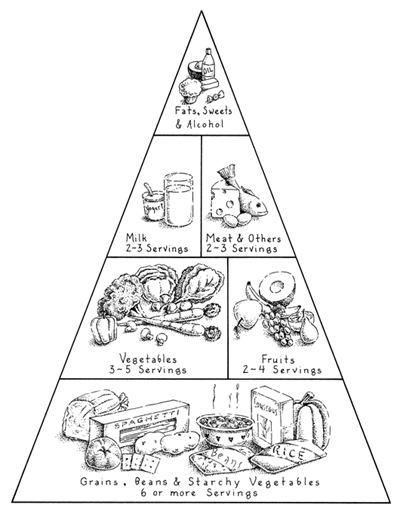
How to Work the Diabetes Food Pyramid
The Diabetes Food Pyramid has six sections for food groups. They vary in size. The largest group -- grains, beans, and starchy vegetables -- is on the bottom. This means that you should eat more servings of grains, beans, and starchy vegetables than of any of the other foods. The smallest group -- fats, sweets, and alcohol -- is at the top of the pyramid. This tells you to eat very few servings from these food groups.
Eat servings from all the food groups other than the fats, sweets, and alcohol, every day. Eat the recommended number of servings on the pyramid within each food group. The exact number of servings you need depends on your diabetes goals, calorie and nutrition needs, your lifestyle, and the foods you like to eat. Divide the number of servings you should eat among the meals and snacks you’re going to eat that day. The Diabetes Food Pyramid makes it easier to remember what to eat. For a healthy meal plan that is based on your individual needs, you should work with a registered dietitian (RD) with expertise in diabetes management. To find an RD with diabetes expertise, read the section below titled
The First Step
For most people a great first step to healthier eating habits is to make a few simple changes. Perhaps you decide to eat more fruits and vegetables and to go lighter on the meats and sweets. If you make these changes and stick to them, pat yourself on the back. That’s a big step in the right direction.
After the First Step
Before you get set to make more changes, make sure you can continue practicing the ones you have made. When you are ready, decide on the next change. Keep it easy to accomplish. Here are some common problems that you may have and some easy solutions to fix them:
Problem:
You realize that your helpings of foods at dinner are too
large.
Solution: Dust
off and use your measuring cups and spoons, and your food
scale to get your serving sizes right.
Problem:
You are heavy-handed with the salad dressing.
Solution: Use the same
salad dressing but measure out 1 tablespoon with a measuring
spoon and spread the salad dressing out with a tasty vinegar.
Problem:
Your breakfast has never been more than a few slurps of juice.
You realize that you should eat more to keep your blood glucose
in control and provide your body with morning energy, but
you don't have the time.
Solution: Pack your
breakfast for the road! Take a half an English muffin or half
a bagel with a half banana, a low fat granola bar with an
apple, or a plain yogurt sprinkled with dry cereal and dried
fruit.
As you continue to change your eating habits to manage your diabetes, the diabetes food pyramid can help you and your whole family eat healthier. Here are some more healthy eating tips:
- Eat a variety of food. Eating a wide variety of foods, even from the same food group, helps you get all the nutrients to be in good health. For example: Within the fruit group, bananas are a good source of potassium and oranges are a good source of vitamin C.
- Balance the food you eat with physical activity -- to maintain or improve your weight. It comes down to basic math. You need to burn as many calories as you eat in order to hold your weight steady. If you want to lose a few pounds, then you need to eat fewer calories than you burn.
- Choose a diet with plenty of grain products, vegetables, and fruits. These foods should provide the mainstay of what you eat. They provide lots of vitamins, minerals, and fiber, yet they provide the least concentrated sources of calories.
- Choose a diet low in fat, saturated fat, and cholesterol. It is well known that eating many foods that are high in fat, particularly ones with too much saturated fat and dietary cholesterol, can contribute to the development of clogged and narrowed arteries. This can lead to heart disease and people with diabetes are at an even greater risk for developing heart disease.
- Choose a diet moderate in sugars. Sugary foods, like jelly beans and regular soft drinks, and sweets, like ice cream and cookies, are not healthy for anyone. They provide a bunch of calories with little or no nutrients. Yet sugary foods and sweets are enjoyable to eat. Strike a balance -- practice moderation.
- Choose a diet moderate in salt and sodium. Americans eat more salt and sodium than they need. Most of the sodium we eat comes from processed foods like cold cuts, prepared foods, canned soups, pickles and olives. To keep your salt and sodium intake moderate, shake the salt shaker lightly and use more fresh and unprocessed foods.
- If you drink
alcoholic beverages, do so in moderation. Alcohol
is loaded with calories and is empty when it come to nutrients.
Practice moderation -- a drink or two a few times a week.
Next Step...Learn More
Starches and Diabetes
The message today: Eat more starches! That’s the opposite of what you’ve heard for years. That’s because research studies now show it is healthiest for everyone to eat more grains, beans, and starchy vegetables. Starches are good for you because they have very little fat, saturated fat, or cholesterol. They are packed with vitamins, minerals, and fiber. Yes, foods with carbohydrate -- starches, vegetables, fruits, and dairy products -- will raise your blood glucose more quickly than meats and fats, but they are the healthiest foods for you. Your doctor may need to adjust your medications when you eat more carbohydrates. You may need to increase your activity level or try spacing carbohydrates throughout the day.
On average Americans eat around 40 to 45 percent of our calories as carbohydrate. This is a moderate amount of carbohydrate, not high. Currently some controversy about carbohydrates is raging due to a few new diet books. These books encourage a low carbohydrate, high protein and moderate fat intake. These diets are not in synch with the American Diabetes Association nutrition recommendations, which are based on years of research and clinical experience. In addition, these trendy diets are hard to follow year after year.
A way to see how carbohydrates affect your blood glucose is to monitor your blood 1&1/2 to 2 hours after meals. Checking your blood glucose at this point tells you how high your blood glucose went from the carbohydrates you ate. For good diabetes control, keep your after-meal blood glucose levels at 180 or below.
To find out more about how to put the food pyramid to work for you...read on. We’ve included the most up-to-date diabetes recommendations regarding each specific food group and quick and easy ideas to change your eating habits for the better. All of this information is from the book Diabetes Meal Planning Made Easy: How to Put the Food Pyramid to Work for Your Busy Lifestyle, written by Hope S. Warshaw, MMSc, RD, CDE, and published by the American Diabetes Association. You can purchase this book in our online bookstore or call 1-800-ADA-ORDER (1-800-232-6733).
Easy ways to eat more grains, beans and starchy vegetables:
* In a meatloaf or meatball recipe, substitute some grain, such as oatmeal,
bulgur or brown rice, for some of the meat.
* Add noodles, peas, or beans to a vegetable soup.
* Prepare a hearty bean or pea soup. Eat some and divide the rest into
individual portions; store the soup in the freezer for a quick meal.
* When you're cooking grains, make enough for extra servings. Then toss
them on salads, into soups or casseroles, or reheat them as leftovers.
* Eat whole grain cold cereal as a snack and pack the small boxes for
snacks on the run.
* Open a can of garbanzo beans (chickpeas) or kidney beans and add them
to a salad, tomato sauce or a three bean salad.
* Treat yourself to great tasting bread with meals, for a snack or as
the main course at breakfast.
* Add crunch to a salad or casserole with fat-free tortilla or potato
chips.
* Have pretzels or light (in fat) popcorn for a snack.
* Buy breads with at least 2 to 3 grams of fiber and hot and cold cereals
with at least 4 grams of fiber per serving.
Vegetables and Diabetes
For people with diabetes, it’s "the more the merrier" when
it comes to vegetables. Eat at least 3 servings a day. Vegetables are
healthy, chock full of vitamins and minerals, and some give you much needed
fiber. The best part: Vegetables are naturally low in calories -- if you
are careful not to top them with butter, sour cream, cream soups, or cheese
sauces. Remember, non-starchy vegetables (those in this food group) do
contain a small amount of carbohydrate -- 5 grams per serving. Don’t
get too carried away, you can even overeat vegetables.
Easy ways to eat your vegetables:
* Keep frozen and canned vegetables on hand to know you always have vegetables
at the ready.
* Make double and triple portions; at a serving one day and have one ready-to-go
for the next.
* Blanch (quick cook and chill) a head of broccoli or cauliflower, break
it into pieces, place in a plastic container and have a ready supply for
the week, hot or cold.
* Keep a bag of pre-cut or baby carrots around -- grab a handful as a
snack, pack them with lunch, throw them into stew, or microwave for a
quick vegetable.
* Microwave or sauté onions and peppers to put more vegetables
into a tomato sauce.
* Toss extra sautéed vegetables on a frozen pizza.
* Make a big salad to last a few days, store in the refrigerator in a
plastic container.
* Add vegetables into sandwiches -- not just the old lettuce and tomato,
try alfalfa sprouts, sliced red onion, sliced cucumbers, sliced yellow
squash or zucchini, red peppers, or leftover grilled vegetables.
* Add vegetables to an omelette or scrambled eggs -- sauté onions,
peppers, mushrooms, tomatoes and add some fresh herbs.
* Drink tomato, V-8 or Bloody Mary mix as a vegetable.
* In a tomato sauce, cut the amount of meat you use in half and add more
vegetables -- onions, peppers, mushrooms, eggplant, zucchini or others.
Fruit and Diabetes
Questions about fruit keep coming up. Will fruit juice increase blood
glucose levels more quickly than a piece of fruit? Should you avoid fruit
in the morning because your blood glucose might be higher than at other
times in the day? Is it better to eat fruit with meals rather than snacks?
All carbohydrates, whether rice, potatoes or fruit juice, raise blood
glucose about the same. In general, an equal amount of carbohydrate (15
grams) such as 1/2 cup grapefruit juice or 4 slices of Melba toast, should
raise blood glucose at about the same speed and about the same amount.
However, that varies based on several factors -- whether you eat a piece
of fruit after a high-fat meal or sip fruit juice on an empty stomach,
what your blood glucose is when you eat the fruit, whether the fruit is
cooked or raw, how much diabetes medication you have in your body, etc.
Also, people have individual differences. So, your challenge is to find
out how fruit works in your body. Does eating fruit in the morning make
it more difficult to keep your blood glucose controlled through the day?
Does one particular kind of fruit send your blood glucose soaring? Or
does a piece of fruit as an afternoon snack give you just enough carbohydrate
to last until dinner? Use blood glucose monitoring to answer your questions
about how fruit works in your body.
Eat some fruit each day for vitamins and minerals. Be honest with yourself
about your serving sizes. It is easy to drink a few extra ounces of fruit
juice or to call a huge piece of fruit 1 serving when it is at least 2.
The steps to take to track your response to fruit are: Check the serving
size, eat your fruit, and check your blood glucose level about 1&1/2
to 2 hours later.
Easy ways to eat more fruit:
* Put slices of banana or peaches on cold cereal.
* Add dry fruit (such as, raisins, apricots, or apples) when cooking hot
cereal.
* Keep a plastic container full of cut up fruit -- have some at breakfast
or for a snack topped with plain or fruited non-fat, sugar-free yogurt
(to get a bit more calcium).
* Take one or two pieces of fruit from home each day to eat with lunch
and as an afternoon snack or on your way home to knock the edge off your
ravenous appetite.
* Keep dried fruit, raisins, figs, apricots, peaches, pears, etc., around
-- use it for a snack, try it as fuel for long hikes or bike rides, or
stash in your desk or locker. But don’t empty the bag -- the calories
and carbohydrate in dried fruit add up quickly because they are concentrated.
* Toss a few raisins, pieces of apple, dried apricot, or pineapple chunks
on a salad.
* Have canned or jarred fruit in the pantry -- applesauce, peaches, pears
and pineapple for starters.
* Toss fruit into entrees -- pineapple in stir-fry or on make-your-own-pizza;
fresh or dried cranberries or peaches in chicken, or apricots or apples
in pork dishes.
* Combine fruit with vegetables -- crushed pineapple in coleslaw, raisins
in carrot salad, make a Waldorf salad with apples, raisins, walnut and
celery.
* Serve fruit with the main course -- applesauce with pork chops or roast,
pineapple with ham, low-sugar cranberry sauce with chicken.
* Grill fruit on skewers and serve as dessert with a few ginger snaps
or vanilla wafers or serve as part of the main course.
Milk and Diabetes
People with diabetes are at the same risk for osteoporosis as the general
public. Fat-free (skim) and low-fat (1%) milk and yogurt will provide
the calcium you need without saturated fat and cholesterol. A serving
of milk or yogurt can be used as a snack or part of a snack -- milk and
crackers or yogurt and fruit. Also, you might find that fat-free milk
or yogurt makes a good food to treat low blood glucose reactions. They
both provide as much carbohydrate as a serving of starch or fruit.
Easy ways to sip and swallow more milk and yogurt:
* Eat more hot cereal, use milk to substitute for at least half (if not
all) the water, use more milk on the cereal as you eat it.
* Eat more high fiber dry cereal, it is a way to drink more milk and get
a good boost of fiber. Don't limit cereal and milk to breakfast, it can
be a quick and easy lunch, dinner or snack. It is a great way to work
in another fruit serving.
* Blend together fruit with fat-free milk or yogurt to make a tasty shake
for a quick snack. Put a serving of milk or yogurt in a blender, toss
in a serving of fruit -- banana, strawberries, or peaches, add a bit of
extract, vanilla, rum or maple -- blend it up and sip it down.
* Create your own yogurt combo -- take plain fat-free yogurt or frozen
yogurt and toss in Grapenuts® and/or low-fat granola cereal, dried
fruit -- diced dried apricots, apples or pears. A few (not too many) nuts
add good crunch.
* Drop a few tablespoons of refrigerated yogurt on fresh or canned fruit.
* Use plain yogurt as a substitute for sour cream on baked potatoes. Mix
in fresh herbs, garlic, Dijon mustard, cayenne or curry (or any combination)
for some extra kick.
* Make yogurt cheese by "hanging" yogurt over cheesecloth or
coffee filter and a strainer. Make it the thickness of cream cheese and
add some no sugar jelly to spread on bagels or toast.
* Keep containers of yogurt in the refrigerator to use as a quick and
convenient snack or part of a meal.
* Add dry milk to recipes where the taste will blend in -- meatloaf or
meatballs, soups, casseroles, gravies.
* Add fat-free milk or dry milk to eggs mixed for scrambled eggs, omelette
or French toast.Protein (Meat, Poultry, Seafood, Cheese, Eggs, Etc.)
People with diabetes have no less or more need for protein than the general
public. The American Diabetes Association nutrition guidelines suggest
eating between 10 and 20% of your calories as protein. The Recommended
Daily Allowance (RDA) for protein is 0.8 grams per kilogram of body weight.
Click here to calculate your minimum RDA for protein.
Another reason to eat less animal protein is to get less fat and cholesterol.
People with diabetes have a greater risk of heart disease earlier in life.
One of the most important nutrition guidelines to follow is "eat
less saturated fat". A quick way to do that is to cut down on animal
protein foods -- meats, whole milk dairy foods, and high-fat cheeses (such
as cheddar, brie, or American). If you cut down on animal protein, you
can be pretty sure you will automatically be cutting down on saturated
fat, and cholesterol as well.
Make Protein S-t-r-e-t-c-h
A way to make small servings of protein appear larger is to incorporate
them into an entree such as low-fat ground beef or turkey sausage in a
tomato sauce served over pasta. For ideas, take lessons from cultures
that have long practiced making a small amount of protein feed many mouths
-- Chinese stir-fry, Mexican burritos, or Japanese sukiyaki. This accomplishes
several pyramid goals -- less meat, less fat, more starches and more vegetables.
From time to time, take these recipes one step further and eliminate meat
all together.
Easy ways to eat less protein:
* Split a sandwich with a friend in restaurants by asking for extra pieces
of bread or additional rolls. Share a salad plate, for example tuna or
chicken salad, and request bread or rolls be served on the side.
* In fast food restaurants, order single, regular, or junior size sandwiches
and stay away from the doubles and triples.
* Order a take-home container (doggie-bag) if you order an entrée
with a serving of meat that is more than 6 ounces. Split the serving when
your plate is set before you. Take it home for lunch or dinner tomorrow.
* Make your own sandwiches with less protein and more vegetables.
* Take up more room on your plate with filling grains, starches, and vegetables
and only leave room on the side for meat. Here’s a thought to keep
in mind when you are preparing and serving food. The meat portion should
take up only 1/4 of your plate. Think of meat as a side dish, not the
main course.
* Buy smaller quantities (just what you need for the purpose) so you eat
less.
* Cook dishes that s-t-r-e-t-c-h protein.
* Load sandwiches with raw vegetables (easier with pita bread because
you can stuff the pocket).
* Start the day without a serving of meat at breakfast. Try a bowl of
cereal, a small bagel, or an English muffin.
* Gather recipes that use less meat and more grains and vegetables --
try to make a new one each week or two.
Fat and Diabetes
Fat ought to make up about 30% of your calories. The total amount of fat
you eat should be based on the foods you like and your goals for eating
healthy and blood lipid (blood fats) and glucose control. You need an
individualized eating plan. For example, a young athlete with type 1 diabetes
might need 4,000 calories a day during football season. He probably needs
to eat 40% of his calories from fat, just to get all those calories. Even
though he is eating a higher number of calories as fat, he still should
choose foods with lower saturated fat and cholesterol and more monounsaturated
fat (such as olive oil, canola oil, avocado, nuts, or olives). That’s
just healthy advice for anyone.
Conversely, a small woman with type 2 diabetes who needs to lose some
weight, may need to keep the amount of fat she eats at about 25% of calories
or below to achieve her nutrition and diabetes goals.
One of the most important diabetes nutrition guidelines is to hold saturated
fat to 10% of calories. Why? Because saturated fat raises blood cholesterol.
High blood cholesterol is a risk factor for heart disease. People with
diabetes have more frequent heart disease. Limiting saturated fat could
lower your risk for this diabetes complication. Also, some people with
abnormal blood lipids (fat) and a high triglyceride might benefit from
increasing the amount of monounsaturated fats they eat. As for cholesterol,
keep it to 300mg or less each day. Some foods high in cholesterol are
egg yolks and organ meats (liver or kidney).
How To Cut Down On Saturated Fat
First and foremost, cut down on total fat. That is a great start. Then
concentrate on decreasing the amount of animal products.
Meats:
* Purchase lean cuts.
* Cut off all visible fat prior to cooking.
* Use preparation methods that get rid of more fat, such as grilling.
* Eat 2-3 ounce portions (cooked). This serving is about the size of the
palm of your hand, a deck of cards, or a mayonnaise jar lid.
Poultry:
* Take off the skin either before or after cooking.
* Eat 2-3 ounce portions (cooked).
Seafood:
*Choose lower fat fish.
*Prepare with small amounts of fat. Eat 2-3 ounce portions (cooked).
Cheese:
* Limit amount you eat.
* Buy part skim, lower calorie cheeses.
Butter:
* Use tub margarine.
* Use butter on occasion, maybe in a recipe.Milk/Yogurt:
* Use the fat-free (skim) varieties. Processed Foods:
* Read the labels of processed foods and check for tropical oils (such
as palm or coconut), and see how far down on the ingredient list they
fall. Ingredients are listed in descending order of predominance in the
product. The ingredient used in the greatest quantity is listed first,
and the ingredient used in the smallest quantity is listed last.
How to tank up on monounsaturated fats:
* Monounsaturated fats are known as the good guys. Monounsaturated fats
offer the benefit of lowering cholesterol, while not decreasing the body's
good cholesterol (HDL).
* Stock canola and/or olive oil in your cupboard. Use these oils to sauté,
cook, prepare salad dressing or bake.
* Throw a few nuts on foods -- salads, desserts, stir-fries.
* Use a slice or two of avocado on a salad, to garnish a casserole, or
for guacamole as a Mexican topping.
* Use a few olives on a relish plate, to toss in a salad, as a garnish.
* Buy canola or olive oil-based commercial salad dressings, canola-based
margarine and mayonnaise or make your own with olive or canola oil.
Easy ways to spare and skim the fat:
* Use fat-free or no more than 1% milk.
* Take advantage of light and reduced fat cheeses. Find out which products you like best. Sometimes you just need to use less of the regular to get the taste you enjoy.
* If a recipe calls for cheese and you want to use a regular type, buy a sharp variety and use a smaller quantity. The sharper taste gives more flavor with a smaller amount.
* Buy the low-fat, light, and fat-free products that taste good to you. You might have to experiment with several -- margarine, butter (or blends), cream cheese, cottage cheese, mayonnaise, and sour cream. Remember, these products are not calorie-free. Be sure to read the Nutrition Facts label to learn more about the product.
* Buy the low-fat, reduced-calorie or fat-free salad dressing that has the taste you like. No matter what salad dressing you use, don't pour on too much. Remember a 1/4 of a cup can contain as many carbohydrates as a slice of bread.
* Use low or no sugar jelly or jam instead of margarine or cream cheese on bagel, toast, or muffins.
* Use plain, fat-free yogurt or fat-free sour cream instead of regular sour cream -- add herbs and seasonings to make it tasty. Use it on baked potatoes, vegetables, chicken and fish.* Always keep fresh lemon and lime on hand to squirt on vegetables and fish at the table instead of adding more fat (such as sauces or butter).* When you buy meats, buy lean cuts; trim off excess fat; prepare in low fat and moist ways.* Marinate meats and vegetables in wine, vinegars, seasonings and spices to add flavors without adding fat.* Consider using applesauce, prune puree or other dried fruit puree to replace fat in baked goods recipes. Check the back of boxes for some recipes or write to the manufacturer to request recipes.
Sugar and Diabetes
Research studies show that, gram for gram, sugars, like table sugar, do
not raise blood glucose any more quickly than do other carbohydrates,
like potatoes, rice or pasta. This research holds true for people with
both types of diabetes.
A variety of factors influence how quickly food is digested. A meal with
a large amount of fat or fiber, lots of raw foods that take more time
to digest, and eating slowly will help keep your blood glucose level on
track. The blood glucose level at the time you eat and how much diabetes
medication is in your body has a major impact, too.
It's Not A Sugar Free-For-All
If and when you choose to eat sweets, according to your individual diabetes
and nutrition goals, substitute these foods for other carbohydrates in
your meal plan. Recall the nutrition message for all Americans, it is
the same for people with diabetes -- "Choose a diet moderate in sugars".
To determine the amount of sugars and sweets to eat, answer these questions:
1. Is your blood glucose in good control and your hemoglobin A1c at a
desirable level?2. Are your blood fats in good control -- total cholesterol,
LDL, HDL and triglycerides?3. How much do you enjoy sugars and sweets,
and how often do you want a small serving to help you stay on track with
your eating plan?
Try a Related Recipe
Get sugar-wise:
* Keep the healthy eating guidelines top of mind.
* Prioritize your personal diabetes goals. Which comes first -- blood glucose control, weight loss, or lower blood fats. Your priorities dictate how you strike the balance with sugars and sweets.
* Choose a few favorite desserts and decide how often to eat these in light of your personal diabetes goals -- maybe twice a week, just when dining out, or only at a special celebration.
* Note the calories, total fat, saturated fat, and cholesterol of the desserts you prefer. Make your choices with these numbers and your diabetes goals in mind.
* Quench your sweet tooth with a small portion of your favorite sweet.
* Split a dessert in a restaurant (ask your server for one serving and four spoons).
* Take advantage of smaller portions when options present themselves, such as at an ice cream or frozen yogurt shop.
* Substitute a sugar-free sweetened food for the regular -- hot cocoa or a popsicle.
* Use the Nutrition Facts panel on food labels to determine the number of grams of carbohydrate per serving size. This will let you know how to swap a sugary or sweet food in your meal plan for a starch, fruit, or milk.
* Test blood glucose and observe the affect of different sugars and sweets. Let this information help you decide what sweets to eat.
* Keep a watch on hemoglobin A1c and blood fats to see if eating more sweets leads these number on an unhealthy up swing.
Alcohol and Diabetes
Beyond all the health and safety concerns about alcohol, if you have diabetes
and are on diabetes medications that lower blood glucose, you need to
practice caution. The action of insulin and some diabetes pills, sulfonylureas
and meglitinides (Prandin), is to lower blood glucose.
Alcohol can cause hypoglycemia shortly after drinking and for 8-12 hours
after drinking. So, if you want to drink alcohol, check your blood glucose
before you drink and eat some foods to prevent low blood glucose. You
should also check your blood glucose before you go to bed to make sure
it is at a safe level -- between 100 and 140 mg/dL. If your blood glucose
is low, eat something to raise it.
The symptoms of too much alcohol and hypoglycemia can be similar -- sleepiness,
dizziness, and disorientation. You do not want anyone to confuse hypoglycemia
for drunkenness, because they might not give you the proper assistance
and treatment. The best way to get the help you need if you are hypoglycemic
is to always wear an I.D. that states "I have diabetes".
Less frequently, alcohol can cause blood glucose to rise. This is due
to the calories from carbohydrates in some alcoholic beverages such as
beer and wine or the calories from a mixer such as orange juice. If you
drink shortly before or while you eat, alcohol might make your blood glucose
rise.
Another problem with alcohol can be that it may lessen your resolve to
stay on track with healthy eating. Contemplate this situation. You sit
at a restaurant and sip a glass of wine while you peruse the menu. As
you slowly relax your tastebuds might be more easily tempted to overindulge.
A Few Guidelines:
* Women should drink 1 or fewer alcoholic beverages a day (1 alcoholic
drink equals a 12 oz beer, 5 oz glass of wine, or 1&1/2 oz distilled
spirits (vodka, whiskey, gin, etc.).
* Men should drink 2 or fewer alcoholic drinks a day.
* If you take insulin, drink alcohol with and in addition to your usual meal plan.
* If you have been told to calculate your alcoholic drink as part of your overall calories, substitute it for a fat serving. For example: 1 alcoholic drink equals 2 fat servings.
* If you drink alcohol at least several times a week, make sure your
doctor knows this before he/she prescribes a diabetes pill.
More Tips to Sip By:
* Drink only when and if blood glucose is under control.
* Test blood glucose to help you decide if you should drink and whether you need to eat something before or as you drink.
* Wear an I.D that notes you have diabetes.
* Sip a drink slowly to make it last.* Have a no calorie beverage by
your side to quench your thirst.* Try wine spritzers to decrease the amount
of wine in the drink.* Use calorie-free drink mixers -- diet soda, club
soda, diet tonic water, or water.* If you take diabetes medications, drink
alcohol with a snack or meal. Some good snack ideas are pretzels, popcorn,
crackers, fat-free or baked chips, raw vegetables and a low-fat yogurt
dip.* Find a registered dietitian to help you fit alcohol into your food
plan.* Do not drive or plan to drive for several hours after you drink
alcohol.The book Diabetes Meal Planning Made Easy is chock full of helpful
information. This is some of what you’ll find:
* More about each food group in the Diabetes Food Pyramid.* An extensive
list of foods for each of the food groups with nutrition information --
calories, carbohydrate, fat, and fiber.* How to fit in sweets and sugary
foods.* What to know about drinking alcohol with diabetes.* Tips on the
difficult art of portion control.* Tactics for supermarket survival.*
How to use the food label with Nutrition Facts to your advantage.* And
more!
For More Help and Support...
To find out exactly how much of what types of foods you should eat, we
suggest you work with a registered dietitian (RD) who has experience working
with people who have diabetes. This person can help support your efforts
to change your eating habits and control your blood glucose level. To
find a registered dietitian near you:
1. Locate the names of American Diabetes Association Recognized Diabetes
Education Programs in your area or call 1-800-DIABETES (1-800-342-2383).
2. Call The American Dietetic Association at 1-800-366-1655. Ask for the
names of dietitians in your area that specialize in diabetes. Or look
on The American Dietetic Association’s web site, located at www.eatright.org,
for a listing of dietitians in your area.