

Kitchen technique · chart
Steak doneness: bleu to well done
The French and English names for each stage, the temperature to take a steak off the heat, what it reaches after resting, and how it looks and feels, so you can serve it exactly the way you like it.
- Pull temperatures
- °C and °F
- French & English terms
- Finger test
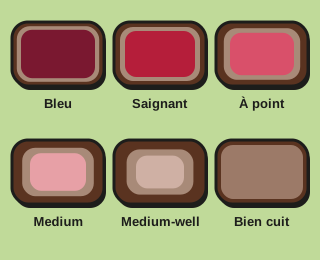
The doneness chart
Push an instant-read thermometer into the thickest part of the steak from the side, so the tip sits in the very middle. Take the steak off the heat at the pull temperature; it keeps cooking as it rests and ends up at roughly the eating temperature.
| French | English | Take off the heat | After resting | How it looks | How it feels | Finger test |
|---|---|---|---|---|---|---|
| Bleu | Very rare (blue) | 43°C (109°F) | about 46°C (115°F) | Seared outside, deep purple-red and only just warm in the middle | Very soft, like raw meat | Hand open and relaxed |
| Saignant | Rare | 48°C (118°F) | about 51°C (124°F) | Dark red centre, warm, with plenty of red juice | Soft, with a little give | Thumb to first finger |
| À point | Medium-rare | 52°C (126°F) | about 55°C (131°F) | Rosy red-pink right across the middle, juicy | Springy but still yielding | Thumb to middle finger |
| no separate term | Medium | 57°C (135°F) | about 60°C (140°F) | Pink in the centre, browner towards the edges | Firm, springs back | Thumb to ring finger |
| no separate term | Medium-well | 63°C (145°F) | about 66°C (151°F) | Mostly brown, just a trace of pink | Firm, little spring left | Between ring and little finger |
| Bien cuit | Well done | 68°C (154°F) | about 71°C (160°F) | Brown-grey all the way through, clear juices | Very firm | Thumb to little finger |
Pull temperatures are for a 2–3 cm (about 1 in) steak resting for 5 minutes. Medium-rare at 52°C is our house figure; the others are set to match it and the sources below. Sources differ: Hawksmoor gives ranges (medium-rare 50–55°C) and takes steaks off at the bottom of each; Serious Eats lifts them off a little lower still before a final butter baste; BBC Good Food lists much higher figures (63°C for medium-rare), close to the US safety guideline rather than to what a steakhouse serves.
Why take it off early?
Carry-over cookingIt keeps cooking on the plate
The outside of a steak is far hotter than the middle when it leaves the pan, and that heat keeps moving inwards while it rests. A 2–3 cm steak usually climbs about 3°C (5°F) in 5 minutes; a 4 cm or thicker one can climb a little more, so take it off a degree or two sooner if you like it at the pinker end.
Getting a true readingUsing the thermometer
- Go in from the side, not the top, and aim for the centre of the thickest part.
- Keep clear of bone and of big seams of fat, which read differently.
- Check a few seconds before you expect it to be ready: it rises quickly at the end.
- Thin steaks (minute steak, steak Diane) are too thin to probe: go by time and colour.
The French terms
Bleu is very rare: seared hard outside, barely warmed through. Saignant (“bleeding”) is rare. À point (“just right”) is medium-rare, though in France it can come out a touch more cooked than a British medium-rare. Bien cuit is well done. French has no separate everyday word for medium or for medium-well, so if you want either in France, say so in English or ask for it between à point and bien cuit.
The finger test
No thermometer? Compare the steak with the fleshy pad at the base of your thumb. Press the steak in the middle with a fingertip of your other hand, then match how it feels:
- Hand open and relaxed: the pad is very soft, like raw or bleu steak.
- Thumb lightly touching your first finger: soft with a little give, like saignant (rare).
- Thumb to middle finger: springier, like à point (medium-rare).
- Thumb to ring finger: firm, like medium.
- Thumb to little finger: very firm, like well done (bien cuit).
It is a rough guide: hands differ, and a lean fillet feels softer than a marbled rib-eye at the same temperature. Gordon Ramsay uses a palm version of the same idea. A thermometer is the only sure way.
The method in brief
- Salt first. Salt the steak well ahead (45 minutes or more, even overnight uncovered in the fridge) or just before cooking. Pat it dry.
- Oil the steak, not the pan. Rub a little oil over the meat and lay it in a heavy pan heated until very hot with nothing in it. On a griddle or barbecue, oil the steak too, never the ridges or bars.
- Sear, then ease off. Sear a minute a side for a crust, then turn the heat down to medium (on a barbecue, move it to the cooler side) and turn it every minute or so. On a griddle, turn it 90 degrees after the first minute on each side for criss-cross marks.
- Pepper and butter in the last minute. In a pan, grind black pepper over both sides in the last minute of cooking (sooner and it can burn). For the optional butter baste, add a knob of butter at the same time and spoon it over as it foams; a sprig of thyme and a garlic clove (whole, lightly crushed, skin on) are optional extras. On a griddle or barbecue, pepper the steak in its last minute on the heat.
- Pull and rest. Take it off at the pull temperature above and rest it for 5 minutes on a warm plate or a rack. After a griddle or barbecue, let a slice of flavoured butter melt on the resting steak instead of a baste.
Steak au poivre is the exception: there the crushed pepper goes on before cooking, because the crust is the dish. Recipes: Sirloin · Rump · Rib-eye · Fillet · T-bone · The steak guide.
Food safety
Whole cuts can be pink; mince cannot. The UK Food Standards Agency says whole cuts of beef and lamb, such as steaks, can be served pink or rare as long as the outside has been properly seared, because any bacteria are on the surface. Minced meat and burgers, rolled joints, pork and poultry are different: cook them right through. The 63°C (145°F) with a 3-minute rest you may see quoted is the US Department of Agriculture’s safety-first guideline for whole cuts; on a steak it eats as medium-well, not medium-rare. If you are cooking for anyone pregnant, very young, elderly or unwell, follow official advice.
Sources for this guide (12)
- Food Standards Agency: Cooking your food (whole cuts of beef and lamb may be pink once seared; mince, rolled joints, pork and poultry cooked through)
- Food Standards Agency: Burgers (why a burger is not like a steak)
- USDA Food Safety and Inspection Service: Safe minimum internal temperature chart (steaks 145°F / 63°C plus a 3-minute rest)
- Hawksmoor: How to cook the perfect steak (temperature ranges, pull at the bottom of the range, rest about as long as it cooked)
- Serious Eats (J. Kenji López-Alt): Perfect pan-seared steaks (salting tests, frequent flipping, butter added for the last minutes)
- BBC Good Food: How to cook steak (doneness descriptions, finger test, salt ahead and pepper just before cooking, its own temperature list)
- BBC Good Food: griddle tips (oil the food, not the griddle; turn 90 degrees for criss-cross marks)
- Gordon Ramsay, BBC Good Food: Mix & match steak (heavy pan, butter baste for fillet and rib-eye, rest at least 5 minutes, prod test)
- Gordon Ramsay’s Ultimate Cookery Course: How to cook the perfect steak (turning every minute, unpeeled crushed garlic, thyme, butter baste, palm test)
- Jamie Oliver: How to cook the perfect steak (oil rubbed on the steak, very hot pan, turn every minute, rest)
- Felicity Cloake, The Guardian: How to cook the perfect steak (no fat in the pan for rib-eye, butter, garlic and thyme to baste, rest 5–10 minutes)
- Weber: Mastering the sear zone (oil the food, not the grates; sear, then slide to indirect heat; rest 5 minutes)
Written 2 November 2026. Facts checked against the sources above on 2 November 2026. Drawing by Cookeryonline.