

Know How · Tea & coffee
Tea, coffee and chocolate drinks
The term beverages covers a range of items. Here we look specifically at tea, coffee and chocolate drinks: types, how they are produced, and how to make them.
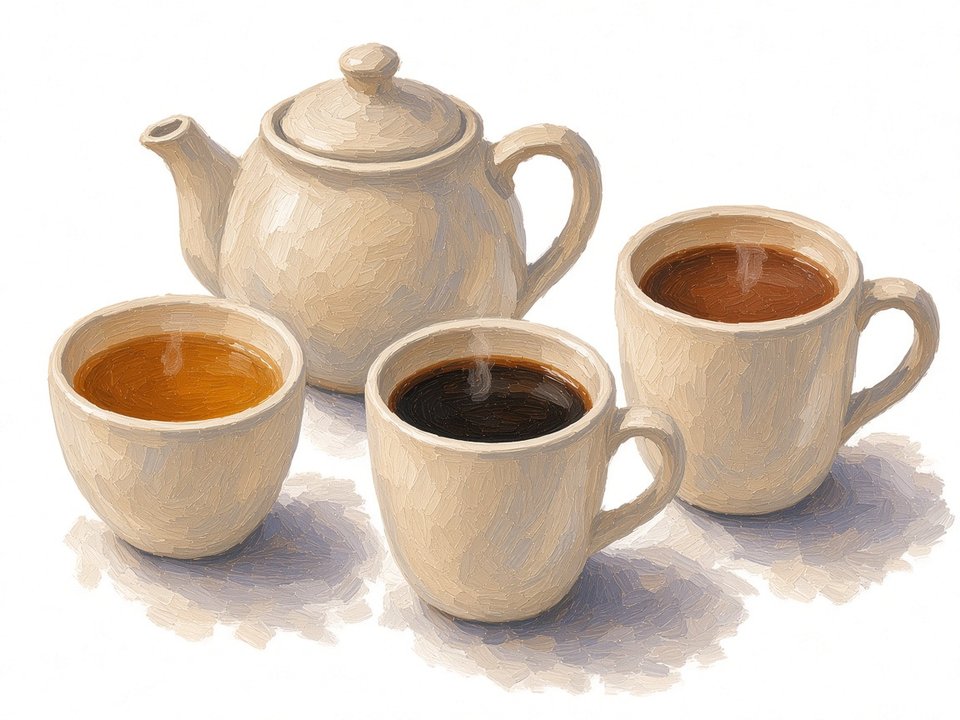
Tea
Tea is probably the most widely consumed beverage in the world. It is made by infusing the dried leaves of an Asiatic evergreen shrub called Camellia sinensis.
The two main varieties of tea plant are those of India and of China. Most teas are cultivated at a height of about 2,000 m and are picked in spring.
History
Tea originated in China in 3000 BC and spread to Japan in about 780 BC. It was not grown in India until the 1840s and in Ceylon (now Sri Lanka) in 1867. Tea was brought to Europe in the 17th century.
At first tea was regarded as a purely medicinal drink, but soon became popular with the aristocracy and then with society in general.
The plant
Although the shrubs can grow to 10 ft high they are usually limited to 4 ft so that the leaves can be easily picked by hand.
The downy terminal bud and the top two leaves are picked from the stem. The smaller and younger the leaves, the better the tea.
The grades of tea
- Orange pekoe
- The highest quality — the tip of the bud.
- Pekoe
- Shorter leaves without the bud.
- Pekoe souchong
- Even shorter, coarser leaves.
- Souchong
- Leaves older still and rolled into balls.
- Broken
- Broken leaves of the above grades.
Main types of tea
- Green tea — unfermented and rolled immediately after harvesting.
- Black tea — fermented and dried.
- Oolong tea — which is semi-fermented.
Green teas
- Gunpowder
- Tychen (coarse gunpowder / imperial tea)
- Moroccan mint tea
- Japanese tea (sencha)
Black tea
Manufacture takes place in five stages:
- Withering — the leaf is dried and softened.
- Rolling — the cells of the leaf are broken down to release a mixture of constituents.
- Moist fermentation — 2–3 hours at 27°C.
- Desiccation — 20 minutes at 90°C.
- Sorting and grading.
Sri Lankan (Ceylon) teas
- Superior orange pekoe
- Flowery orange pekoe
- Uva Highland
- Medium-grown broken orange pekoe
- High-grown broken orange pekoe
Indian teas
- Darjeeling
- Assam
- Bengal
China teas — ordinary teas
- Yunnan
- Caravan
- Keemun
- Great Mandarin
China teas — steamed teas
- Imperial souchong
- Lapsang souchong
- Tarry souchong
Oolong
A semi-fermented tea from Taiwan which is popular in the USA.
Scented teas
- Earl Grey — oil of bergamot
- Jasmine
- Rosehip
- Georgia tea — citrus fruits and flowers
Numerous other teas.
Storage: keep in a dry, airtight container away from light.
How to make tea
- Use water that is as lime-free as possible and freshly drawn.
- Rinse out the pot with boiling water and add one teaspoon per person and one for the pot.
- Take the pot to the kettle and pour in the water just as it reaches boiling point.
- Infuse for three to five minutes — remove teaballs or infusers.
- Just before serving, stir the tea and, if the leaves are left in the pot, use a strainer.
Tisane
A tisane is an infusion of herbs and dried plants that is drunk hot, on its own or slightly sweetened. For example: camomile, lemon balm, wild thyme, meadowsweet, mint and lime blossom, and so on.
Russian tea
Served in a glass with a wedge of lemon in a squeezer.
Iced tea
Usually flavoured with lemon or mint and sweetened.
- How much tea is required to make a litre?
- How much tea is required to make a pint?
- How many portions are there in a litre?
Coffee
The coffee tree, which bears small red berries that contain seeds known as coffee beans, originally came from Sudan and Ethiopia but is now widely cultivated.
Earliest known date 1420. Venetians imported the first coffee in 1615.
Two main species of coffee tree are:
- Coffea arabica — elongated, oval and flat beans which are mild and aromatic.
- Coffea robusta (also known as canephora) — smaller and more convex, contain 2.5 times more caffeine, and produce a more full-bodied and bitter drink.
These two varieties make up 95% of world production. Minor varieties include Liberica and Excelsa.
Production of coffee
- The fruits are treated to remove pulp; the “green” coffee is graded and bagged.
- Roasting. The beans are continuously stirred during the roasting process. The degree of roasting is a matter of taste: the more the coffee is roasted, the stronger and more bitter the resulting coffee. The range is from very light roast (popular in the USA), medium roast (Italy and France), high roast (Holland and Germany), to very high roast (Middle East and Turkey).
- Grinding. The fineness of the grinding depends on the method used to brew the coffee. Ideally it should take place just before the coffee is made.
Storage: store in a sealed container in a refrigerator. Coffee loses its aroma quickly after roasting.
Caffeine: this alkaloid gives coffee its stimulating quality.
Types of coffee
Coffee can be divided into the country of origin and the degree of roasting, as well as type of bean. The most famous producers are: Brazil, Arabia, Colombia, Ethiopia, Mocha (Yemen), Mexico, Costa Rica, Ivory Coast, Angola, DR Congo (Democratic Republic of the Congo) and so on.
- Viennese
- Coffee with the addition of fig essence.
- Decaffeinated
- With caffeine removed.
- Instant
- Spray dried, freeze dried or liquid extract.
- Chicory mixtures
- Produce a cheap, strong, heavy drink.
Methods of making coffee
- Filter coffee
- Percolated
- Vacuum infusion — Cona
- Espresso — pressurised steam forced through the coffee. Cappuccino: strong espresso coffee to which frothy cream or milk is added; a pinch of powdered chocolate is served on top.
- Turkish method — poured into boiling water with almost equal quantities of sugar. This mixture is heated up to the point of boiling three times; a few drops of cold water are added to settle the grounds, then served in cups or small glasses.
- Cafetière or plunger pot
- Urn
- How much ground coffee is required to make a litre?
- How much ground coffee is required to make a pint?
- How many portions are there in a litre?
Cocoa and chocolate
The cocoa plant is a small tropical tree originally grown in Central and South America, but now grown largely in West Africa.
The fruit is a large pod 4–12 inches in length and about 4 inches in diameter. It has a leathery rind and contains 25–75 seeds in 5 rows.
Two main species of cocoa are Criollo and Forastero.
Production
- Fermenting to prevent germination and to encourage enzymes which develop flavour.
- Drying either in the sun or in drying chambers.
- Roasting to develop flavour and aroma and give even colour.
- Winnowing — removes the shell, leaving nibs.
- Alkalising (Dutch processing) — the nibs are tumbled in a warm alkali solution; this further develops flavour.
- Grinding — the nibs are ground into very small particles. This process releases a lot of fat called cocoa butter, and the mass becomes a thick syrup.
- Extracting — some of the fat is removed and the solid mass is pulverised and sieved, leaving a fine powder.
Types
- Cocoa powder
- The powder resulting from the above process, which can be made into a drink by adding hot water or milk.
- Plain chocolate
- The mass is mixed with sugar, refined and standardised (conched), and set in slabs or bars. This product is also known as couverture.
- Milk chocolate
- As above, with the addition of milk “crumb”: that is, condensed milk and mass reduced to powder form.
- Drinking chocolate
- Prepared from chocolate powder or flakes with the addition of hot milk or water.
Other brands
- Nesquik
- Cadbury’s
- Bournvita
They have the addition of malted extracts.
- Horlicks
- Ovaltine