
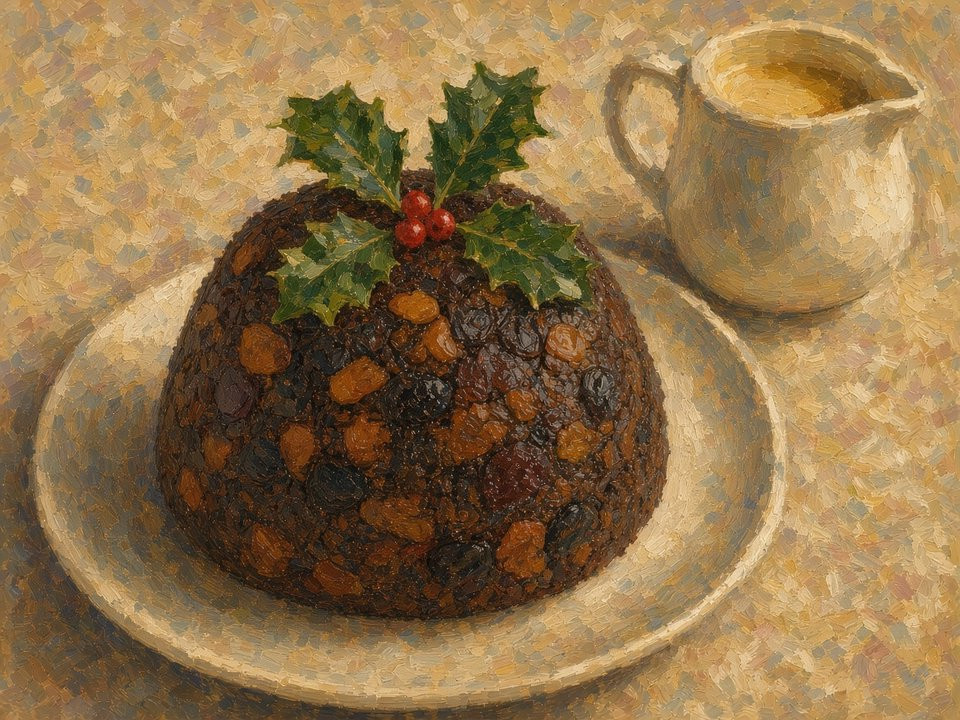

Photo: cookeryonline.com
Desserts
Vegan Christmas Pudding


Recipe No. 0670
A vegan steamed Christmas pudding: make it on Stir-up Sunday (22 November in 2026), reheat it on the day and serve with vegan custard or oat cream.
For the traditional pudding with suet and eggs, see Christmas Pudding.
- Makes 3 × 750 g puddings in 1.1 litre (2 pint) basins
Method
Make the flax eggs 10 minutes ahead (2 tbsp ground flaxseed mixed with 6 tbsp water). Mix all the dry ingredients together.
Mix the flax eggs, brandy, oat or soya milk and syrup together and add to the dry ingredients.
Leave the mix to stand for an hour.
Meanwhile grease 1.1 litre (2 pint) pudding basins, one for each 750 g portion.
Weigh the mixture in 750 g portions and place into the pudding basins.
Cover with greased greaseproof.
Cover with either a cloth or aluminium foil, secure with string.
Steam over steadily boiling water for approx. 8 hrs.
Remove from the steamer and allow to cool.
Then cover with a clean dry cloth or foil, store in a cool dry place.
Tip: tap a step to tick it off as you cook.
Rate this recipe
Tried it? Rate it.
The readers’ average appears here once 5 readers have rated it.
One vote per recipe per browser, and you can change it. We keep only the stars: no name, e-mail or IP address. How ratings work
Chef’s notes
- Check the water in the steamer regularly so it does not dry out.
- You will also need greaseproof paper and string.
- Make the puddings four to six weeks ahead if you can. Stir-up Sunday (22 November in 2026) is the traditional day. Feeding with brandy or rum is optional — there is more on this under Ageing and feeding, below.
- To reheat on the day, steam for a further two hours. Steaming is best; the microwave is quicker (see Reheating under Ageing and feeding).
- Brandy is usually vegan, but some wines and spirits are fined with animal products: check the label if it matters.
- For a gluten-free pudding, use gluten-free breadcrumbs at the same weight, and check the labels on the vegetable suet, spices and mixed peel. If you use oat milk, check the label if you need it to be gluten-free.
- A smaller pudding: these amounts make 750 g portions, each filling a 1.1 litre (2 pint) basin. Use the portions control to make fewer, and weigh the mixture in 750 g portions as in the method.
- If you miss Stir-up Sunday, you can still make this pudding closer to Christmas — it can be eaten as soon as it has been steamed and reheated. A last-minute or microwave pudding can be a variation, not a replacement.
Serve with
Vegan custard, or oat cream with a little brandy stirred in. The usual brandy sauce is made with butter and milk, so it is not vegan.
A little history
Christmas pudding started life as a pottage rather than a pudding. The food historian C. Anne Wilson traced its ancestry to an early 15th-century recipe, “Stewet Beef to Potage”: beef simmered in wine with onions, herbs, cloves, mace, raisins and currants and thickened with bread. A sweet cousin, “fygey”, a thick porridge of figs, raisins, almonds, wine and honey, appears in The Forme of Cury, compiled for Richard II’s cooks around 1390. Neither was yet a Christmas dish.
By Elizabethan times the dish was called plum pottage (first recorded in 1573), “plum” meaning any dried fruit: raisins, currants or prunes. William Rabisha listed plum porridge as a Christmas dish in 1673, and in 1726 the Swiss visitor César de Saussure wrote that everyone in England, “from the King to the artisan”, ate Christmas porridge. During the 18th century the meat dropped out, leaving suet as its last trace, and a stiffer mixture tied in a floured cloth and boiled became the round plum pudding printed by cookery writers such as Mary Kettilby (1714) and John Nott (1723).
The Victorians made it the crowning dish of Christmas dinner. Charles Dickens’s A Christmas Carol (1843) fixed the picture of Mrs Cratchit’s pudding, “like a speckled cannon-ball”, blazing in brandy with holly stuck in the top; two years later Eliza Acton’s Modern Cookery for Private Families printed the first recipe actually called a Christmas pudding, and in 1861 Mrs Beeton noted that a sprig of holly was usually set in the middle and the pudding carried in “encircled in flame”. Moulds and basins, and later steaming, slowly replaced the cloth.
Puddings are traditionally made on Stir-up Sunday, the Sunday before Advent, named after the Book of Common Prayer collect for that day, which begins “Stir up, we beseech thee, O Lord, the wills of thy faithful people”. The link with stirring puddings began as a joke on those words (the Oxford English Dictionary calls it jocular) and became the custom of every member of the household taking a turn to stir and make a wish. In 2026 Stir-up Sunday is 22 November; Advent Sunday is 29 November.
A silver threepence or sixpence was often stirred into the mixture, bringing wealth in the coming year to whoever found it; the custom comes from the older practice of baking tokens into the Twelfth Cake, and some families added a ring, a thimble or a tiny wishbone as well. The sprig of holly on top and the flaming brandy are both described by Dickens and by Mrs Beeton.
Disputed stories: three popular tales do not stand up well. That George I, “the Pudding King”, asked for plum pudding at his first English Christmas in 1714 is disputed: the Old Royal Naval College finds no 18th- or 19th-century record of it, and the story seems to appear first in May Byron’s Pudding Book in the early 20th century. That Oliver Cromwell banned plum pudding is disputed: the Puritan authorities suppressed Christmas services and festivities, but no law named the pudding. That Prince Albert introduced the pudding, or the sixpence custom, is disputed too: the Royal Mint repeats it, but plum pudding was a Christmas dish more than 150 years before his marriage to Queen Victoria in 1840.
Ageing and feeding
How long to mature it
The pudding can be eaten as soon as it has been steamed and reheated, but the spices and brandy mellow with time. Make it four to six weeks ahead if you can (Stir-up Sunday is the traditional day). Well wrapped and kept cool it will last for months; Mrs Beeton made five or six at a time because “they will keep good for many weeks”. With less dark sugar, stout and fruit than the richest puddings, this one has less to gain from very long ageing: a month or two is plenty.
Storing
When the pudding is completely cold, take off the steaming papers, re-wrap it in fresh greaseproof paper or baking parchment and then foil (paper first, so the fruit never touches the foil), and tie it with string. Keep it somewhere cool, dark and dry, such as a larder or an unheated room, not a warm kitchen cupboard; Delia Smith suggests under the bed in an unheated bedroom.
Feeding with brandy or rum
Feeding is optional: a steamed pudding stays moist without it. For a boozier pudding, prick the top a few times with a skewer and spoon over 1–2 tablespoons of brandy or rum every week or two, then re-wrap tightly. Stop about a week before Christmas and do not overdo it, or the pudding turns soggy.
Food safety
Keep the pudding dry: damp wrappings invite mould, so change them if they get wet. Before reheating, unwrap it and check that it smells sweet and spicy with no mould, sliminess or sour smell; if in doubt, throw it out. If you hide a coin or token, wash and boil it first, wrap it in a twist of baking parchment if you like, tell everyone it is there, keep it away from small children, and take it out before microwaving. To flame the pudding, warm the brandy in a ladle or small pan, light it away from anything flammable, and never pour spirit straight from the bottle near a flame.
Reheating: steaming or microwave
Steaming is best: steam the wrapped pudding over simmering water for about 2 hours (as in the method), topping up with boiling water; it heats right through and stays moist and dark. The microwave is quicker: remove the foil and any coin, cover loosely and heat on medium power in short bursts with a rest between them until piping hot in the centre. Gordon Ramsay suggests about 10 minutes on medium for a 1.25-litre pudding; slices need much less. Microwaving can dry and toughen the edges, so serve it straight away. Leftovers reheat well wrapped in foil in the oven, as Delia Smith suggests.
How this pudding compares
This is a mid-depth Christmas pudding: fruity and spiced, but lighter in colour, texture and richness than the dark, heavily fruited puddings of Mrs Beeton or Delia Smith. Here is how it differs from those richer styles.
| This pudding | Heavier, richer traditional puddings | |
|---|---|---|
| Fruit | About 1 : 1 fruit to dry ingredients, but only about 2 : 1 fruit to breadcrumbs, so there is plenty of soft crumb between the fruit. Raisins, sultanas, peel and glacé cherries; no currants. | Up to about 2 : 1 fruit to dry ingredients and 3–5 : 1 fruit to flour and crumbs; currants (small, dense and dark) are usually a big share. |
| Sweetness and colour | Brown sugar and golden syrup, no stout or treacle; carrot and apple keep it moist. A mid-brown pudding flecked red with cherries. | Dark muscovado or soft dark brown sugar, often stout or barley wine (Delia Smith) and long steaming make it very dark, almost black. |
| Flavour | Warm ginger and mixed spice, fruity but not cloying; a little brandy. | Deep, dark and boozy, with more spice, citrus zest and often nuts. |
| Texture | Lighter, more open and cake-like, from the high proportion of breadcrumbs. | Dense, moist and heavy, packed with fruit. |
| Ageing needed | Good after a few weeks; a month or two is plenty. | Often made months ahead and fed with spirit to mature. |
| Who it suits | Anyone who finds traditional pudding too heavy after a big dinner, children, and cooks who start late. | Lovers of a dark, rich, intensely fruity pudding with a long brandy finish. |
Fruit ratio, worked out
This recipe uses 890 g of dried fruit, peel and cherries (450 g raisins, 200 g sultanas, 120 g peel, 120 g cherries) to 900 g of dry ingredients (450 g breadcrumbs, 225 g vegetable suet, 225 g sugar): about 0.99 : 1. Measured against its breadcrumbs alone, it has about 2.0 times as much fruit, the lowest of the five recipes below. By the first measure it sits level with Delia Smith’s pudding and well below Mrs Beeton’s and BBC Good Food’s; Eliza Acton’s, which she called “a remarkably light small rich pudding”, has a little less fruit again.
| Recipe | Dried fruit and peel | Dry ingredients | Fruit : dry | Fruit : flour and crumbs |
|---|---|---|---|---|
| This pudding (Cookeryonline No. 0670) | 890 g | 900 g | 0.99 : 1 | 2.0 : 1 |
| Eliza Acton, The Author’s Christmas Pudding (1845) | 14 oz | 17 oz | 0.82 : 1 | 2.3 : 1 |
| Delia Smith, A Traditional Christmas Pudding | 520 g | 495 g | 1.05 : 1 | 3.2 : 1 |
| Mrs Beeton, Christmas Plum-Pudding No. 1328 (1861) | 40 oz | 24 oz | 1.67 : 1 | 3.3 : 1 |
| BBC Good Food (Orlando Murrin), Classic Christmas pudding | 1200 g | 590 g | 2.03 : 1 | 5.0 : 1 |
Dry ingredients = breadcrumbs + flour + suet or butter + sugar, by weight, from each recipe as published. Fresh apple and carrot, nuts, eggs, spices and liquids are left out of both columns. Mrs Beeton’s pudding has no sugar at all: its sweetness comes from the fruit.
A cook-by-cook survey of ingredients and timings follows.
How other cooks vary it
The history of the pudding is in the section above. This recipe is a mid-depth, breadcrumb-and-vegetable-suet pudding: raisins, sultanas, peel and glacé cherries, a little carrot and apple, brown sugar and golden syrup, and a splash of brandy, steamed for eight hours in 1.1 litre basins. Other well-known British recipes keep that idea of a fruit-heavy steamed pudding, but they differ on almost everything else.
Ingredients
Fat. Delia Smith and Nigella Lawson still use shredded suet (beef or vegetarian; Delia’s site also allows grated butter). Mary Berry’s BBC Food pudding, Orlando Murrin’s BBC Good Food classic, Gordon Ramsay, Waitrose and BBC Good Food’s easy pudding use butter instead — sometimes creamed like a cake, sometimes grated cold from the fridge. The Hairy Bikers use sunflower oil. Felicity Cloake, testing recipes for the Guardian, found that butter makes a denser pudding than suet, and kept packet suet in her own version.
Fruit and extras. Currants are usual in the darker puddings — Delia uses more currants than raisins. Nigella soaks prunes with currants and sultanas in Pedro Ximénez sherry; Nigel Slater adds figs, apricots and glacé cherries, and prefers grated quince to apple; Jamie Oliver uses dates, apricots, cranberries, pecans, crystallised ginger and a little rosemary. Carrot appears in some home-style recipes, including ours; Cloake tried apple and carrot, as in Gary Rhodes’s pudding, and preferred the texture without them. Almonds or mixed nuts are a common extra, and citrus zest is almost universal.
Flour, sugar and spice. Ours is flour-free and breadcrumb-heavy, which keeps it lighter and more open. Most modern recipes use both flour and breadcrumbs; Mary Berry’s BBC pudding goes the other way, with more self-raising flour than crumbs, creamed with butter. Sugars run from light muscovado (Berry, the easy pudding, Cloake) to soft dark brown or muscovado (Delia, Nigella, Ramsay, Waitrose). Mixed spice is the usual base, often with nutmeg or cinnamon; Nigella uses cinnamon and cloves instead; ours is unusual in leading with ground ginger.
Alcohol. Delia builds colour and depth with rum, stout and barley wine (or extra stout if barley wine is hard to find). Ramsay soaks the fruit in Guinness; the Hairy Bikers add stout to the mix; Cloake soaks the fruit in Pedro Ximénez, like Nigella, and also adds stout. Mary Berry, Waitrose and the BBC Good Food classic use a smaller measure of brandy, rum, sherry or, at Waitrose, Calvados. BBC Good Food’s easy pudding has no alcohol in the mixture.
Eggs are usually two or three; Cloake, Jamie Oliver and the easy pudding use one; Slater, making two large puddings, uses six. This version uses flax eggs instead of hens’ eggs.
Cooking and maturing
First steaming times vary as much as the ingredients. Delia, the BBC Good Food classic, and Mary Berry (if steamed) take eight hours on the first cook; Good Housekeeping, Ramsay and the Hairy Bikers take six; Nigella five (then a long three-hour reheating); Cloake, Jamie Oliver and Waitrose four; Slater three and a half; the easy pudding only two and a half. Reheating is usually another one to three hours of steaming (Delia 2 hours 15 minutes; the BBC classic only one hour). Mary Berry also gives a seven-hour boil in a pan of water, and the BBC classic can be boiled or oven-steamed. BBC Good Food has a slow-cooker pudding: ten hours on low, then four hours to reheat, in a 1-litre basin. Nigella’s site also gives Instant Pot and pressure-cooker timings: a short ordinary steam, then two hours at high pressure, and 40 minutes to reheat. For a last-minute pudding, BBC Good Food has a different, mincemeat-based mixture cooked in the microwave on medium for 20–25 minutes on the day. To reheat a conventional pudding, steaming is still the usual advice; Mary Berry, Nigella, Ramsay and the easy pudding also give microwave times (Ramsay, already noted above, about 10 minutes on medium for a 1.25-litre pudding).
Basin sizes run from about 1 litre to Nigella’s 1.7 litre. Several recipes make two puddings from one mix (Slater two 1.5 litre basins; the BBC classic two 1.2 litre), as ours does with three 1.1 litre basins.
How far ahead. Delia, Good Housekeeping and Nigella work to several weeks (Nigella up to six weeks, or the pudding can be frozen for up to a year). Waitrose says it will keep for up to three months; the Hairy Bikers and the BBC slow-cooker recipe say up to six months, sometimes with a weekly splash of brandy. The easy pudding is shorter-lived: a few days in the fridge, or two to three weeks frozen. Ours, as the notes above say, is good after a few weeks; a month or two is plenty.
| Recipe | Fat | What stands out | Basin | First cook / reheat |
|---|---|---|---|---|
| This pudding | Vegetable suet | Breadcrumbs only; carrot and apple; a little brandy | 3 × 1.1 litre | 8 hrs / 2 hrs |
| Delia Smith | Suet | Mostly currants; rum, stout and barley wine; flour added the next day | 1.2 litre | 8 hrs / 2¼ hrs |
| BBC Good Food classic | Grated butter | 1 kg raisins; two puddings; boil or oven-steam | 2 × 1.2 litre | 8 hrs / 1 hr |
| Mary Berry (BBC Food) | Creamed butter | Apricots in the fruit; cake-style method | 1.4 litre | 8 hrs steam or 7 hrs boil / 2 hrs |
| Nigella Lawson | Suet | Prunes soaked in Pedro Ximénez; cinnamon and cloves | 1.7 litre | 5 hrs / 3 hrs |
| Felicity Cloake | Suet | PX-soaked fruit, stout, treacle, brown breadcrumbs | 1.4 litre | 4 hrs / 1½ hrs |
| Nigel Slater | Suet | Figs, apricots, cherries; two large puddings | 2 × 1.5 litre | 3½ hrs / 3½ hrs |
| Jamie Oliver | Suet | Dates, cranberries, pecans, ginger and rosemary; served with Bourbon and golden syrup | 1.5 litre | 4 hrs / reheat time not given |
| The Hairy Bikers | Sunflower oil | Wholemeal flour and crumbs; stout; orange segments | 1.2 litre | 6 hrs / 2 hrs |
| Waitrose classic | Creamed butter | Stem ginger; orange and lime; Calvados or brandy | 1.2 litre | 4 hrs / 2 hrs |
| Good Housekeeping | Suet | Treacle, ginger wine or milk, optional almonds | 1.1 litre | 6 hrs / 2 hrs |
| Gordon Ramsay | Grated butter | Fruit soaked in Guinness; dates | 1.25 litre | 6 hrs / 1 hr, or microwave 10 mins |
| BBC Good Food easy | Grated butter | Cup measures; no alcohol; mixed nuts | 1.5 litre | 2½ hrs / 1½ hrs, or microwave 7 mins |
Figures are taken from the recipes as published, checked 17 November 2026. Links go to the source pages.
See also
- Christmas Pudding (the traditional pudding with suet and eggs)
- Brandy Sauce (not vegan)
- Christmas Cake
- Mince Pies
- Christmas cookery (our Christmas pages)
- Steaming: how it works
Sources for these notes
- University of Leeds Library: Stewet Beef to Potage (Special Collections)
- National Geographic: Deconstructing Christmas pudding: secrets of a seasonal staple
- The Guardian: The history of 'plumb porridge' at Christmas
- London Museum: A Sainsbury’s history of Christmas pudding
- Old Royal Naval College: George I - 'Pudding King'?
- Irish Examiner (Robert Hume): Debunking all the myths about plum pudding
- The Royal Mint: Stir-Up Sunday and the Christmas Sixpence
- Wikipedia: Christmas pudding
- The Church of England: Book of Common Prayer: collect for the Sunday next before Advent
- Project Gutenberg (Charles Dickens): A Christmas Carol (1843)
- Mrs Beeton: Christmas Plum-Pudding, No. 1328 (1861), via BBC Wales
- Eliza Acton: The Author's Christmas Pudding (1845), via Chest of Books
- Delia Online (Delia Smith): A Traditional Christmas Pudding
- BBC Good Food (Orlando Murrin): Classic Christmas pudding
- Nigella Lawson: Feeding Christmas Cakes and Puddings (Ask Nigella)
- Gordon Ramsay Restaurants (Gordon Ramsay): Christmas Pudding
- BBC Good Food: Easy Christmas pudding
- Mary Berry: Christmas pudding (BBC Food)
- Nigella Lawson: Ultimate Christmas Pudding
- Nigella Lawson: cooking the Ultimate Christmas Pudding in a pressure cooker or Instant Pot (Ask Nigella)
- Felicity Cloake, the Guardian: How to cook the perfect Christmas pudding (2016)
- Nigel Slater, the Guardian: Christmas pudding, from The Kitchen Diaries (2005)
- Jamie Oliver: Christmas pudding
- The Hairy Bikers: traditional Christmas pudding
- Waitrose: Classic Christmas pudding
- Good Housekeeping: The ultimate rich Christmas pudding
- BBC Good Food (Esther Clark): Slow cooker Christmas pudding
- BBC Good Food: Quick microwave Christmas pudding
History and ageing notes checked 31 October 2026. Survey of other cooks checked 17 November 2026. The notes are written in our own words; the recipe above is unchanged.
Shopping list for 3 puddings
Fruit & veg
Baking
Wine & drinks
Store cupboard (check you have)
Converted from Cookeryonline’s original recipe archive.