
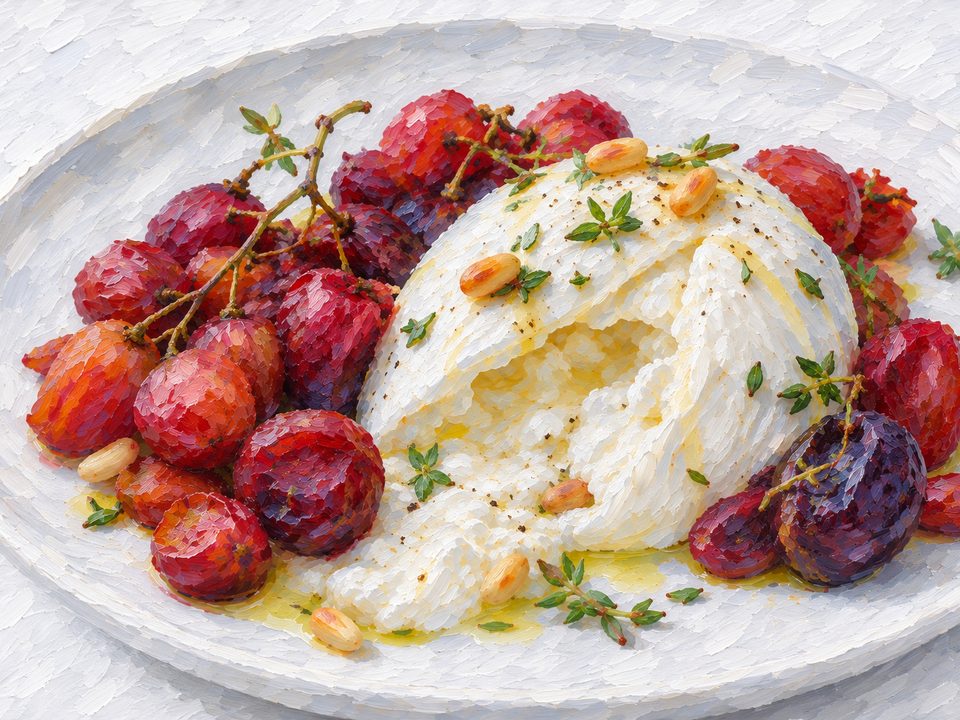

Photo: cookeryonline.com

Starters
Burrata with Roasted Grapes

Recipe No. 0708
Whole burrata with red grapes roasted until jammy with thyme and balsamic, toasted pine nuts and a little olive oil. A sharing plate, or half a burrata each, served warm or at room temperature. Change the portions and units below and the amounts update.
- Serves 4
- About 30 minutes, including 20 minutes roasting
- Italian-inspired
- Make ahead: moderate; roast the grapes ahead and bring the burrata up just before serving
- Vegetarian with a vegetarian burrata (check the label)
Why we make it this way
Burrata is mozzarella with a cream-filled centre. Roasting grapes with thyme and balsamic concentrates their juice into a sharp-sweet syrup, which cuts the richness of the cheese. It is a sharing starter that looks generous and needs only one tray in the oven.
Published versions are close to one another: roast the grapes, sit the burrata beside them, add nuts and a balsamic drizzle. We use pine nuts, which are already in our pantry, and roast the grapes with a little balsamic in the tin so you do not need a separate glaze. The weights are proposed and still need a kitchen trial.
Method
Before you start
- Choose pasteurised burrata and check the label if you are cooking for vegetarians (see the holly-berry note and Chef’s notes).
- Take the burrata out of the fridge 20–30 minutes before serving, so the centre is soft and creamy, not fridge-hard.
- Use firm red or black seedless grapes; very ripe, thin-skinned grapes collapse too quickly in the oven.
Heat the oven to 200°C (180°C fan), gas mark 6. Put the grapes in the roasting tin, toss with 1 tbsp of the oil, the thyme, balsamic, the honey if using, and a little salt and pepper.
Roast for 15–20 minutes, shaking the tin once, until the grapes are wrinkled and some have burst, and the juices in the tin are syrupy. Leave to cool for 5–10 minutes: they should be warm, not scalding.
Meanwhile, toast the pine nuts in a dry frying pan over a medium heat for 2–3 minutes, shaking the pan, until golden. Tip onto a plate so they do not keep cooking.
Pat the burrata dry and sit the balls on the serving plate. Spoon the warm grapes and their juices around and over them. Drizzle with the remaining oil, scatter with the pine nuts and a little flaky salt, and finish with thyme leaves.
Take the plate to the table with the toast. Cut into the burrata at the table so the creamy centre runs into the grape juices. Allow half a ball each.
Tap a step to tick it off.
Rate this recipe
Tried it? Rate it.
The readers’ average appears here once 5 readers have rated it.
One vote per recipe per browser, and you can change it. We keep only the stars: no name, e-mail or IP address. How ratings work
Varieties
These are sourced variations, not separate recipes. The cost box is for the main recipe.
- Pistachios or walnuts. Many published plates use chopped pistachios instead of pine nuts; walnuts are a cheaper British alternative.
- Crostini. Spoon a little burrata and grapes onto toasted baguette slices, as in some American published versions, if you would rather serve canapés than a sharing plate.
- With figs. Roast a few halved figs in the same tin when they are in season.
- Goat’s cheese. BBC Good Food roasts grapes with honey and thyme for a Christmas cheeseboard, and recommends a fresh goat’s cheese if you cannot get burrata.
- Vegan. Use a soft vegan cheese or a thick cashew cream, leave out the honey, and keep the roasted grapes and nuts.
See also
Chef’s notes
- Make ahead. Roast the grapes up to a day ahead; cool, cover and refrigerate, then bring them back to room temperature or warm them for 5 minutes in a low oven. Toast the nuts and keep them airtight. Dress the plate only when you are ready to eat, so the burrata does not sit in warm juices and split.
- Pregnancy. The NHS lists pasteurised burrata among the soft cheeses that are safe to eat in pregnancy, alongside mozzarella and ricotta. Check the label: it must be pasteurised, kept chilled, and used by its date. Some small-batch burrata is made from unpasteurised milk; do not use that. Check the current NHS advice.
- Allergens: milk (burrata) and tree nuts (pine nuts). Balsamic vinegar may contain sulphites. Check the labels.
- Drain the burrata well and pat it dry, or the plate will be watery.
A little history
Burrata was first made in Andria, in Puglia, in the early twentieth century, as a way of using the scraps of mozzarella and the cream. It travelled more widely only in the last few decades, and is now a supermarket cheese in Britain.
Roasting grapes for a cheeseboard is an older European habit; pairing them with burrata is a contemporary starter. The Cookeryonline Christmas starters research of 18 November 2026 listed it among the newer ideas, as part of a wider cheese-sharing trend.
How other cooks vary it
This is a short, sourced note, not a counted desk survey. The details below are described in outline only; they belong to those cooks and are not interchangeable with this recipe.
| Source | Cheese and grapes | Nuts and dressing | What stands out |
|---|---|---|---|
| This recipe (proposed, untested) | 2 × 150 g burrata; 400 g red grapes | Pine nuts; balsamic and thyme in the roasting tin | Sharing plate, grapes served warm; 4 portions. |
| BBC Good Food, Roasted grapes | A bunch of red grapes (no cheese in the recipe) | Honey and thyme, no vinegar or nuts | Roasted 25 minutes at 200°C; suggested with a fresh goat’s cheese. |
| Indi Hampton, With Spice | 8 oz (about 225 g) burrata; 8 oz grapes | Salted pistachios and aged balsamic | Grapes tossed with oil and thyme only, then a balsamic drizzle. |
| Grapes from California, Crostini | 8 oz burrata; 3 cups grapes | Pistachios, basil, baguette | Grapes roasted with balsamic and oil; served as crostini for 8. |
Sources for these notes
- Cookeryonline, Christmas Day Starters 2026: Revised Research Report, 18 November 2026 (Sections B and D).
- BBC Good Food, Roasted grapes.
- With Spice, Burrata with roasted grapes (Indi Hampton).
- Grapes from California, Balsamic-roasted grape and burrata crostini.
- NHS, Foods to avoid in pregnancy (pasteurised burrata and other soft cheeses; unpasteurised milk).
Research behind the recipe
These notes are from published burrata and roasted grape recipes and the Christmas starters research of 18 November 2026, not from a kitchen trial. The weights (400 g grapes, 300 g burrata, 25 g pine nuts, 2 tbsp balsamic, 4 portions) are proposed and still need a trial, especially the roasting time.
The heading is “Research behind the recipe” rather than “How this recipe was developed”, because no kitchen trial has been logged. Costs are from our pantry (Tesco), not from the estimate bands in the research paper.