

Photo: cookeryonline.com

Starters
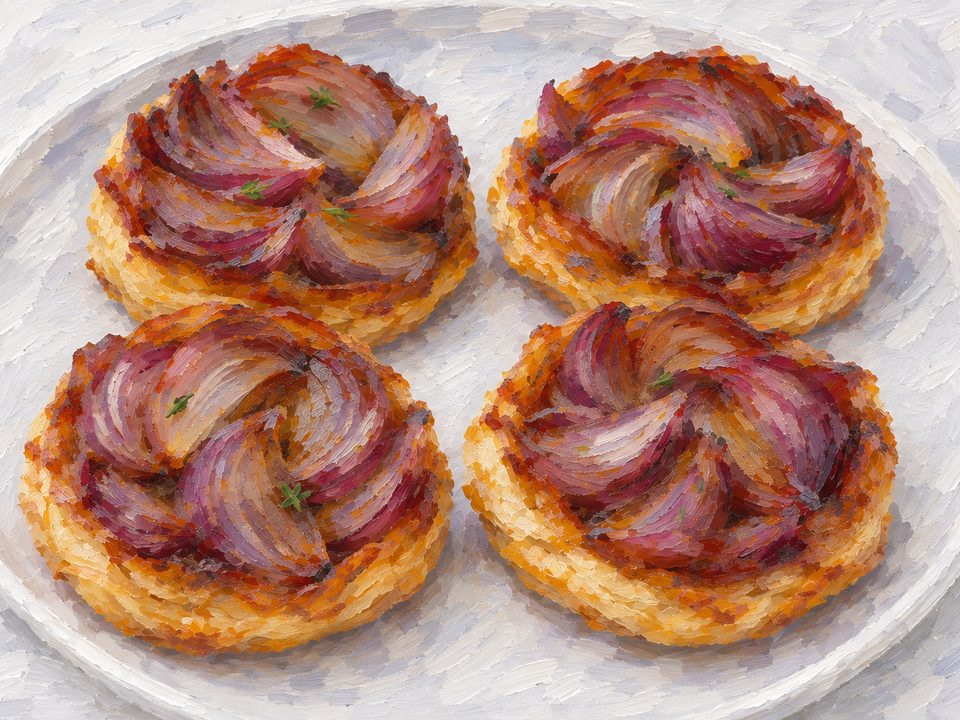
Onion Tarte Tatins

Recipe No. 0706
Little upside-down tarts of red onion halves, soft and sticky in a balsamic caramel with thyme, baked under puff pastry and turned out, with an optional topping of goat’s cheese. Assemble them the day before and bake to order. Change the portions and units below and the amounts update.
- Serves 4
- About 1 hour (40 minutes cooking), plus 20 minutes chilling
- French-inspired
- Make ahead: good; assemble the day before and bake when needed
- Vegetarian with vegetarian pastry and cheese (check labels)
Why we make it this way
A tarte tatin is baked upside down, so the pastry stays crisp and the onion underneath cooks in its caramel until it is soft and glossy. Made individually, each guest gets a whole tart turned out onto the plate: it looks impressive but uses a block of puff pastry and two onions.
We soften the onion halves in the caramel on the hob first, so they are fully tender before the pastry goes on and the bake only needs to crisp the pastry. They can then be assembled and chilled the day before and go into the oven while everyone sits down. Nigel Slater makes the same point: the onions must be fully cooked before the pastry goes on. It is a composite of several published versions (sources below), and the weights and tin size are proposed and still need a kitchen trial.
Method
Before you start
- Keep the root on the onions when you halve them: it holds the layers together so each half turns out whole.
- Choose a pastry labelled vegetarian, and check the goat’s cheese if you are cooking for vegetarians (see the holly-berry notes). All-butter puff pastry tastes best; many standard puff pastries are made with vegetable fats.
- If your tin is not non-stick, grease each hole lightly with butter.
Melt the butter in the frying pan over a medium heat. Sprinkle in the sugar and cook without stirring, swirling the pan now and then, for 3–5 minutes until it melts into a golden-amber caramel. Take care: caramel is very hot.
Take the pan off the heat and stir in the balsamic vinegar, water and thyme; it will splutter. Return to a low heat and stir until any hard bits of caramel dissolve. Season with salt and pepper.
Lay the onion halves in the pan, cut side down. Cover and cook gently for 15–20 minutes, until a knife slides easily into the onion. Uncover and simmer for a few minutes more, until the liquid is a thick, sticky glaze. Watch it closely so it does not burn.
Put one onion half, cut side down, in each hole of the tin, and spoon the glaze over and around them. Leave to cool for at least 15 minutes.
Roll out the pastry on a lightly floured surface to about 3 mm thick and cut four 12 cm rounds. Lay a round over each onion and tuck the edges down inside the hole, around the onion. Prick each one twice with a knife. Chill for 20 minutes (or cover and chill overnight).
Heat the oven to 200°C (180°C fan), gas mark 6, with the baking tray inside. Set the tin on the hot tray and bake for 20–25 minutes, until the pastry is puffed and deep golden.
Leave for 2–3 minutes, then run a palette knife round each tart. Put a board over the tin and, wearing oven gloves, turn it over quickly so the tarts drop out, onion side up. Spoon any glaze left in the tin over them.
If using the goat’s cheese, crumble it over the hot tarts and return them to the oven on the tray for 3–5 minutes, until the cheese is soft and hot right through. Scatter with thyme and serve warm with the dressed watercress.
Tap a step to tick it off.
Rate this recipe
Tried it? Rate it.
The readers’ average appears here once 5 readers have rated it.
One vote per recipe per browser, and you can change it. We keep only the stars: no name, e-mail or IP address. How ratings work
Varieties
These are sourced variations, not separate recipes. The cost box is for the main recipe.
- White onions and cider vinegar. BBC Good Food’s individual version uses white onions charred in a pan and baked, a dark caramel sharpened with cider vinegar, and ash-rolled goat’s cheese on top.
- One large tart. Use a 20–23 cm ovenproof frying pan, 3–4 onions in wedges and a 25 cm round of pastry. Bake for 25–30 minutes and cut into wedges.
- Shallots. Use 300 g peeled whole shallots in place of the onion halves, packed tightly in each hole.
- Vegan. Use a vegan puff pastry, olive oil instead of butter, and leave out the goat’s cheese or use a vegan alternative.
- Other cheeses. A little blue cheese, or shavings of a vegetarian hard cheese, instead of goat’s cheese.
See also
Chef’s notes
- Make ahead. Cook the onions and assemble the tarts with the pastry up to a day ahead; cover the tin and keep it in the fridge. Bake straight from the fridge, allowing 2–3 minutes longer. You can also bake them a few hours ahead, keep them in the tin and reheat at 180°C (160°C fan), gas mark 4, for 8–10 minutes until hot through before turning out.
- Pregnancy. Use a pasteurised, rindless soft goat’s cheese. The NHS advises pregnant women to avoid mould-ripened soft cheeses with a white rind, including some goat’s cheeses, unless they are cooked until steaming hot. Check the current NHS advice.
- Allergens: gluten (wheat in the pastry), milk (butter, pastry and goat’s cheese) and sulphites (balsamic vinegar). Check the labels.
- Caramel burns badly. Keep children away from the hob while you make it and when you turn the tarts out.
A little history
The tarte Tatin is credited to the Tatin sisters, Stéphanie and Caroline, who ran a hotel at Lamotte-Beuvron in the Loire valley in the late nineteenth century, and it was made famous in Paris in the early twentieth century. The original is an upside-down apple tart; the story that it began as a mistake is popular but not proven.
Savoury tatins of onion, shallot or tomato are a modern variation on the method. The Cookeryonline Christmas starters research of 18 November 2026 listed individual onion tarte tatins among the newer ideas, as a familiar ingredient in a new format.
How other cooks vary it
This is a short, sourced note, not a counted desk survey. The details below are described in outline only; they belong to those cooks and are not interchangeable with this recipe.
| Source | Onions | Caramel and pastry | What stands out |
|---|---|---|---|
| This recipe (proposed, untested) | 2 red onions, halved; softened in the caramel on the hob | Butter, sugar and balsamic; 250 g puff pastry, 12 cm rounds | Assemble ahead in a Yorkshire pudding tin; optional goat’s cheese after turning out. |
| BBC Good Food | 3 large white onions, halved, charred then baked 25 minutes | Dark caramel with cider vinegar on a lined tray; 320 g ready-rolled pastry | Six tarts; chilled 1 hour; ash goat’s cheese baked on top. |
| Delia Smith, Complete Christmas | Two jars of ready-made caramelised red onions | 375 g ready-rolled puff pastry, part-baked as a 23 cm square | Not upside down: a quick open tart with goat’s cheese and thyme. |
| Nigel Slater, The Observer | 500–600 g small onions cooked slowly in 75 g butter, no sugar | 250 g puff pastry over the pan; 20–30 minutes | One shared tart; stresses the onions must be fully soft before the pastry goes on. Melting cheese served alongside. |
Sources for these notes
- Cookeryonline, Christmas Day Starters 2026: Revised Research Report, 18 November 2026 (Sections B and D).
- BBC Good Food, Onion and goat’s cheese tarte tatins.
- Delia Online, Red onion and goats’ cheese tart.
- Nigel Slater, An onion tatin, The Observer, 2010.
- NHS, Foods to avoid in pregnancy (soft and mould-ripened cheeses).
- Maison Tatin, Lamotte-Beuvron, History (the hotel’s own account).
Research behind the recipe
These notes are from published onion tarte tatins and the Christmas starters research of 18 November 2026, not from a kitchen trial. The weights (2 red onions, 40 g sugar, 25 g butter, 250 g puff pastry, four 12 cm rounds in a 4-hole Yorkshire pudding tin) are proposed and still need a trial, especially the tin size and turning out.
The heading is “Research behind the recipe” rather than “How this recipe was developed”, because no kitchen trial has been logged. Costs are from our pantry (Tesco), not from the estimate bands in the research paper.