

Chicken Dishes
Roast Goose
Recipe No. 0662
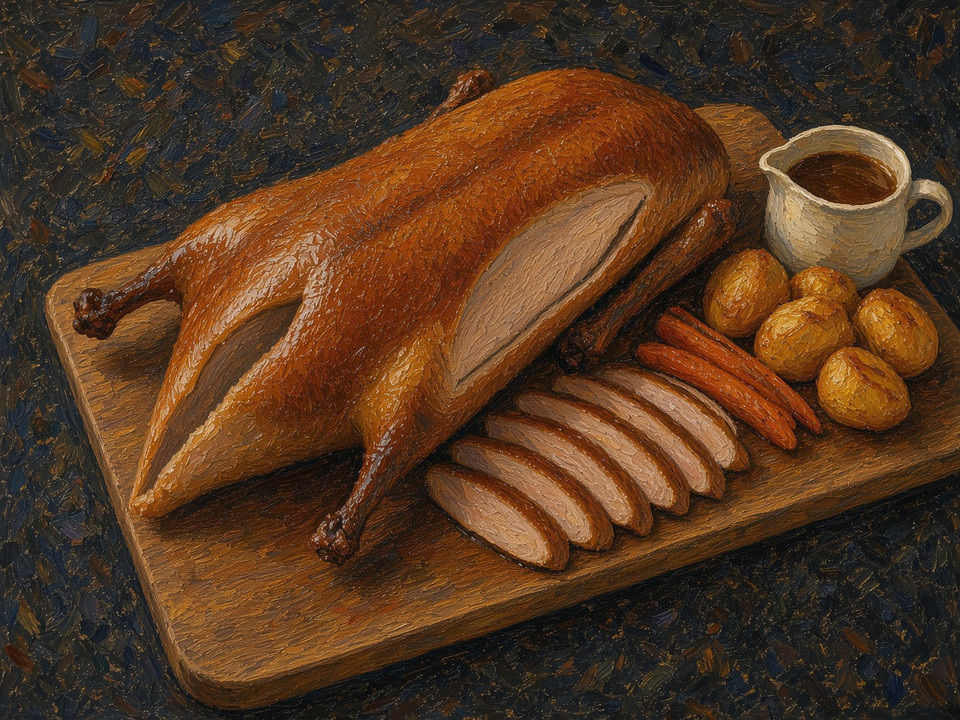
A whole roast goose the Chef Col way: the skin is pricked, the bird starts hot then finishes at 180°C until the probe reads 75°C, the plentiful fat is poured off and saved, and the tin makes a cider gravy.
- Serves 6
- Cooking time about 3–3¾ hrs for a 4.5 kg bird, plus 15–30 min resting
- British
- 4.5 kg goose
- Probe thermometer essential
The portions control scales the gravy and flavourings, not the bird’s cooking time. Use the actual weight of the goose and the probe; the timing guide does not change with portions.
Method
Take the goose (4.5 kg) out of the fridge about 1 hour before cooking (if it was frozen, it must be fully thawed in the fridge first). Remove the giblet bag and any large pads of fat from the cavity; keep the neck for the gravy if it is supplied, and keep the fat. Do not wash the bird. Wash your hands and clean surfaces after handling raw poultry. Heat the oven to 200°C (180°C fan) [400°F / gas 6].
Prick the skin all over with a skewer, especially under the wings and around the legs, piercing the fat but not the meat. If you like a tighter skin, sit the goose in a clean sink and pour a kettle of boiling water over it, then pat it thoroughly dry — this is optional. Season the cavity and the skin generously with sea salt flakes and black pepper. Put the onions (2, halved), apple (1, in wedges), a bay leaf and a sprig of sage or thyme in the cavity for aroma. Cook any stuffing in a separate dish.
Sit the goose on a rack in a large roasting tin, breast up. Roast at 200°C (180°C fan) [400°F / gas 6] for 15–20 minutes, then lower the oven to 180°C (160°C fan) [350°F / gas 4]. Roast until the thickest part of the thigh reads 75°C [167°F] on a clean probe, away from the bone, and the breast is at 75°C [167°F] as well, with clear juices and no pink. As a guide, allow about 40–50 minutes per kg in total, including the hot start — about 3–3¾ hours for a 4.5 kg bird. Start probing well before the low end of the time. The clock is for planning only.
Every 30 minutes or so, carefully pour or ladle the rendered fat from the tin into a heatproof bowl. You will get a lot — save it for roast potatoes. If the skin is browning too much, cover the breast loosely with foil and take the foil off for the last 20–30 minutes so the skin can crisp.
Take the goose out only when every thigh and breast reading is 75°C [167°F], going by the lowest one. The FSA and Food Standards Scotland advise cooking goose through, like duck, to 75°C [167°F]. We do not use a pink or medium-rare finish on a whole goose. Lift it onto a large board, cover loosely with foil and rest for 15–30 minutes (30 minutes is comfortable on a bird this size). It will not go cold. Add any resting juices to the gravy.
For the gravy, if you have the neck, brown it in a little of the fat with a chopped onion and carrot, then add the cider or wine (300 ml) and reduce by about half before adding the hot stock (750 ml) and simmering. Otherwise, skim the roasting tin, leaving 2 tbsp fat and the juices, stir in the flour (2 tbsp), cook for a minute, then add the cider or wine and the stock and simmer. Strain, taste and season.
Carve the breast in long, fairly thin slices and cut the legs into joints or slices. Serve with the gravy. Apple sauce and roast potatoes cooked in the goose fat are the natural partners.
Rate this recipe
Tried it? Rate it.
The readers’ average appears here once 5 readers have rated it.
One vote per recipe per browser, and you can change it. We keep only the stars: no name, e-mail or IP address. How ratings work
See also
Chef’s notes
- Oven and time: 200°C (180°C fan) [400°F / gas 6] for 15–20 minutes, then 180°C (160°C fan) [350°F / gas 4], about 40–50 minutes per kg in total, including the hot start. That is the figure on our Roasting Know How page. A 4.5 kg bird is about 3–3¾ hours as a planning range. Start probing well before the early time. If the reading is short, keep roasting and check every 15 minutes. The thermometer, not the clock, has the last word.
- Food safety: cook goose all the way through to 75°C [167°F] in the thickest part of the thigh and of the breast, juices clear, no pink. The FSA and Food Standards Scotland treat goose like duck in this respect. Some recipes offer a shorter, pinker timing; we do not. Rest for 15–30 minutes, loosely covered.
- Goose gives a great deal of fat and a modest amount of meat — that is the nature of the bird, not a fault in the cooking. Pour the fat off during roasting and keep it; it is one of the best fats there is for roast potatoes. Refrigerate once cool; it keeps for weeks, or it can be frozen.
- The apple and onion in the cavity are for aroma. Cook stuffing in a separate dish, not packed tight in the bird, so the heat can get through and the stuffing itself reaches a safe temperature.
- Goose breasts are shallower than turkey: carve them in long, thin slices, at a slight angle to the breastbone. Take the legs off and slice or joint them.
- Leftovers (UK FSA): carve remaining meat into small portions promptly; cool quickly and refrigerate within 2 hours, counting resting and serving time too. Eat within 48 hours, or freeze in labelled portions. Reheat only once, until steaming hot all the way through.
Safety guidance: FSA cooking food safely, Food Standards Scotland: cooking food safely, and FSA cooking and leftovers.
Weight and timing guide
These times follow our roasting page: 200°C (180°C fan) [400°F / gas 6] for 15–20 minutes, then 180°C (160°C fan) [350°F / gas 4], about 40–50 minutes per kg in total, including the hot start. They are a guide for planning only. A bigger bird takes longer for the heat to reach the centre. Start checking early and take it out only when the probe reads 75°C [167°F] in the thickest part of the thigh and of the breast.
| Weight | Serves (guide) | Oven | Planning time (total) | Rest |
|---|---|---|---|---|
| 4 kg | 5–6 | 15–20 min at 200°C (180°C fan) [400°F / gas 6], then 180°C (160°C fan) [350°F / gas 4] | about 2 hr 40 min–3 hr 20 min | 15–30 min |
| 4.5 kg | 6 | 15–20 min at 200°C (180°C fan) [400°F / gas 6], then 180°C (160°C fan) [350°F / gas 4] | about 3 hr–3 hr 45 min | 15–30 min |
| 5 kg | 7–8 | 15–20 min at 200°C (180°C fan) [400°F / gas 6], then 180°C (160°C fan) [350°F / gas 4] | about 3 hr 20 min–4 hr 10 min | 15–30 min |
| 5.5 kg | 8 | 15–20 min at 200°C (180°C fan) [400°F / gas 6], then 180°C (160°C fan) [350°F / gas 4] | about 3 hr 40 min–4 hr 35 min | 15–30 min |
Take it out at 75°C [167°F]. After a 15–30 minute rest it should still be at or a little above that temperature. Times per kilo are a guide only. If any reading is short, give it another 15 minutes, tenting browned skin loosely with foil, and probe again.
The older Christmas roast
Goose was the usual Christmas roast in England for a long time, before turkey became the everyday festive bird in the twentieth century. It is richer, with more fat and less meat than a turkey of the same weight, and the saved fat is part of the point of cooking one.
The method here is a whole bird, cooked through, with the fat poured off as it goes and a proper rest before carving.
How this recipe was developed
The oven steps and the 40–50 minutes-per-kilo guide come from our Roasting Know How page (the old roasting chart’s times, kept when that page was written). The finish temperature is 75°C, from the FSA and Food Standards Scotland, which replaced the old chart’s 85°C. We compared Delia Smith, Jamie Oliver, Gordon Ramsay, BBC Good Food, Raymond Blanc and Gisslen, then wrote our own whole-bird method to agree with the roasting page.
- Hot start, then 180°C, about 40–50 minutes per kg (our roasting page). Delia’s roast goose also starts hotter, then continues at 180°C for a long roast, and she tests the leg for clear juices. BBC Good Food’s Classic roast goose with cider gravy (4.8/5 from 12 ratings) uses 200°C, covers the bird for much of the time and pours the fat off in stages. We keep the site’s oven and the per-kilo guide, and we finish by the probe at 75°C [167°F].
- Prick the skin, roast on a rack, and pour off the fat (Delia, Gordon Ramsay, BBC Good Food). This is the practical heart of roasting a goose. Gordon’s Christmas roast goose (4.5/5 from 40 ratings) also scores the skin, pours the fat off every half hour and rests the bird for at least 30 minutes; we take the pouring-off and the rest, but not his shorter medium-rare timing, which would leave the meat below our safe finish.
- Cook it through to 75°C [167°F] (FSA, Food Standards Scotland, our roasting page). Jamie Oliver’s roasting guide gives a slower 180°C roast (about 3 hours for a 4–5 kg bird, 40 minutes’ rest, meat soft and not pink), which we compared but did not adopt for the oven steps. Raymond Blanc’s BBC Good Food goose (4.3/5 from 10 ratings) cooks the legs and the crown on different timings; that is a good restaurant method, but this page is a whole bird for a home oven.
- Cider gravy, and apple in the cavity (BBC Good Food, Delia). The classic BBC Good Food gravy is built on cider and the neck; Delia uses apple in a stuffing. We put apple and onion in the cavity for aroma and make a cider (or wine) gravy, and we cook any stuffing separately.
Sources we compared (ratings as shown on each site on 12 November 2026):
- Cookeryonline: Roasting Know How (oven, times and 75°C finish)
- Food Standards Agency: cooking food safely (cook goose through)
- Food Standards Scotland: cooking food safely (75°C; goose cooked through)
- Delia Smith: Roast Goose with Forcemeat and Spiced Cranberry and Apple Stuffing
- BBC Good Food: Classic roast goose with cider gravy (4.8/5, 12 ratings)
- BBC Good Food (Gordon Ramsay): Gordon’s Christmas roast goose (4.5/5, 40 ratings)
- BBC Good Food (Raymond Blanc): Raymond’s roast goose (4.3/5, 10 ratings)
- Jamie Oliver: handy guide to roasting meat
- Professional Cooking (Gisslen), chapters 16 and 18
This is an original Cookeryonline recipe written in our own words. Ingredient choices and techniques are credited above; no source text has been copied.