

Ingredients · guide
UK and US beef cuts
British and American butchers divide a side of beef differently and use some of the same words for different cuts. Here is each British cut with its American name, where it comes from and how to cook it, with a diagram for each country and the names that trip people up.
- 2 diagrams
- 20 cuts and shop names
- Lamb and pork notes
Two ways to cut a sideThe cuts on the animal
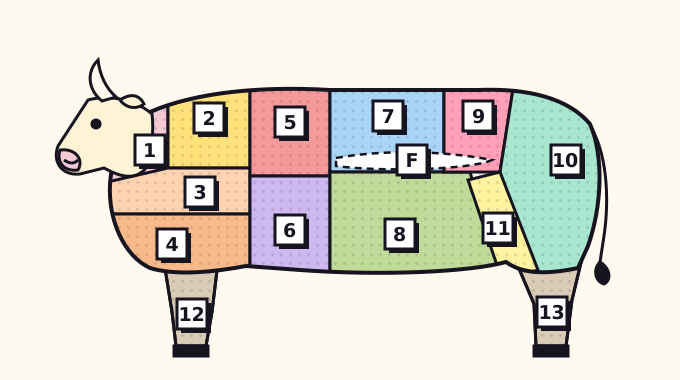
Both charts show the same side of beef. British butchers cut it into many smaller named joints; American butchers first divide it into eight large primal cuts and then cut those into retail cuts. The lines are approximate: every chart, and every butcher, draws them a little differently. Tap a name to jump to its row in the table.
UK: butchers’ cuts
US: primal cuts
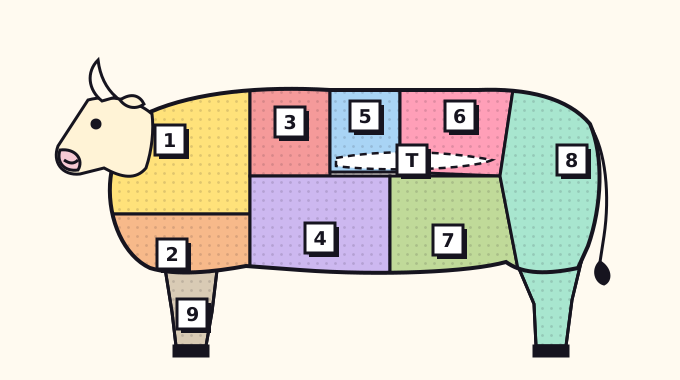
The US chuck runs back to the 5th rib and the US rib section covers ribs 6 to 12 (USDA meat purchase specifications), so the American chuck takes in meat that a British butcher sells as neck, clod, chuck and blade and thick rib.
Same word, different steakThe names that trip people up
- Sirloin is not sirloinUK sirloin = US New York strip
A British sirloin steak is the American New York strip (or strip steak, strip loin). In a US shop or steakhouse, ask for strip if you want the steak a British cook calls sirloin.
- US sirloin is close to UK rumpUS top sirloin ≈ UK rump
The American sirloin is further back, at the hip. A top sirloin steak is the nearest thing to a British rump steak. Americans divide the hip a little differently, so the match is close rather than exact.
- Topside, silverside and the roundUS “round” = UK topside + silverside + thick flank
The whole hind leg is the round in the US. Topside is top (inside) round, silverside is bottom (outside) round with the eye of round, and thick flank is the knuckle. Confusingly, the US also calls the knuckle sirloin tip, and may call bottom round a rump roast: neither comes from the sirloin or the rump.
- Brisket, salt beef and corned beefUK salt beef = US corned beef
Brisket is brisket on both sides of the Atlantic. British butchers usually sell it boned and rolled; US shops sell the leaner flat and the fattier point. Cured in brine, it is salt beef in the UK and corned beef in the US, where a tin of British-style corned beef would be “canned corned beef”.
- Chuck is bigger in the USUS chuck = UK neck + clod + chuck and blade, and more
In the UK, chuck and blade is a joint from the top of the shoulder. In the US, chuck is the whole shoulder section: it includes the neck, the clod and the first five ribs. A US chuck roast is the cut for pot roast; in the UK you would ask for a chuck, blade or brisket joint for braising.
- Fillet, filet mignon and T-bonesUK fillet = US tenderloin
Fillet is tenderloin in the US, and its steaks are filet mignon. A US porterhouse is a T-bone with a wide piece of fillet (USDA: at least 3.2 cm, 1¼ in); British butchers often call any large T-bone a porterhouse.
Every cut, both namesUK and US beef cuts: the table
Numbers match the UK diagram. Where a US name covers more (or less) than the British cut, the closest match is given first. For how long to cook each steak, see Steak doneness: bleu to well done; for the pan, griddle and barbecue methods, see Perfect Steak.
| UK name | US name(s) | Where on the animal | Best cooking methods |
|---|---|---|---|
| Forequarter: neck, shoulder, ribs and breast | |||
| 1Neckoften sold as stewing steak or mince | Part of the chuck (chuck neck); stew meat, ground beef | In front of the shoulder | Long stewing and braising; mince |
| 2Chuck and bladebraising steak, feather blade, chuck steak | Chuck: chuck roast, chuck eye, chuck roll, blade steak; the feather muscle becomes flat iron or top blade steak; the under-blade gives the Denver steak | The upper shoulder, over the shoulder blade | Braising, stewing, pot-roasting, slow cooking; flat iron and Denver steaks are tender enough to grill medium-rare |
| 3Clodstewing steak | Shoulder clod (part of the US chuck): arm roast, clod heart, ranch steak | The middle of the shoulder, above the fore shin | Stewing, braising, mince |
| 4Brisketusually boned and rolled, sometimes salted | Brisket: sold whole or as the leaner flat and the fattier point (deckle) | The breast, between and in front of the front legs | Slow roasting, pot-roasting, braising; salted for salt beef (US corned beef); smoked low and slow in US barbecue |
| 5Fore ribrib of beef; boned: rib-eye steak; on the bone: côte de boeuf | Rib (ribs 6 to 12): standing rib roast, prime rib, ribeye, bone-in ribeye or rib steak, cowboy and tomahawk steaks | The middle of the back, in front of the sirloin | The classic roasting joint, on or off the bone; steaks for the pan, griddle or barbecue |
| 6Thin rib and thick ribJacob’s ladder (the rib bones and meat); thick rib often sold as braising steak | Short ribs (from the short plate and the chuck), also cut across the bones as flanken | The lower ribs, below the fore rib | Slow braising, slow roasting or smoking until the meat comes away from the bone |
| 12Shin (fore shin)also sold as stewing steak | Fore shank; shank cross-cuts | The front leg, below the clod | Long, slow stewing and braising (it turns rich and gelatinous); stock; shin on the bone for osso buco-style dishes |
| The back: sirloin, fillet and rump | |||
| 7Sirloinsirloin steak, entrecôte, sirloin joint, wing rib | Short loin and strip loin: New York strip, strip steak, Kansas City strip, strip roast. T-bone and porterhouse are cut across the short loin, with the fillet attached | The back, behind the ribs | Roasting joint; steaks for the pan, griddle or barbecue |
| FFilletfillet steak, tournedos, chateaubriand | Tenderloin: filet mignon, tenderloin steak, tenderloin roast, chateaubriand | Under the backbone, inside the sirloin, running back into the rump | Quick cooking: pan-fry, sear then roast, beef Wellington; best rare to medium-rare |
| 9Rumprump steak; rump cap (picanha); rump tail; in Scotland, thin rump steaks are popeseye | Sirloin (the US primal): top sirloin steak and roast, sirloin steak; the rump cap is top sirloin cap, coulotte or picanha; the rump tail is tri-tip (from the bottom sirloin) | The hip, between the sirloin and the topside | Steaks for the pan, griddle or barbecue, rare to medium; roast in one piece; picanha and tri-tip suit the barbecue |
| The hind leg (the US round) and the belly | |||
| 10Topsideroasting joint, often with a layer of fat tied round it | Top round (inside round): top round roast or steak; a thick top round steak is often sold as London broil | The inside of the hind leg | Roast to pink and carve thinly; pot-roasting, braising in slices; beef olives; thin frying steaks |
| 10Silversidethe round eye muscle inside it is the salmon cut (eye of silverside) | Bottom round (outside round flat) and eye of round; some US shops call a bottom round joint a rump roast | The outside of the hind leg | Pot-roasting, braising and boiling; salted and simmered for salt beef; roast only to pink, with fat added |
| 11Thick flankalso sold as top rump; minute and frying steaks | Knuckle, also called sirloin tip or round tip (it is part of the round, not the sirloin); ball tip | The front of the hind leg, above the knee | Slow roasting or pot-roasting as a joint; braising in pieces; thin frying steaks and stir-fry strips |
| 13Leg (hind shin)stewing steak | Hind shank (part of the US round) | The hind leg, below the knee | As shin: long, slow stewing and braising; stock |
| 8Thin flank and skirtbavette; thin and thick skirt; onglet, which hangs from the diaphragm | Flank steak; skirt steak (outside and inside skirt, from the short plate and flank); hanger steak (onglet); flap meat or sirloin bavette | The belly, below the loin and ribs | Very hot and fast, rare to medium-rare, sliced thinly across the grain (fajitas, steak frites); or slow braising and mince |
| Shop names that are not one cut | |||
| Stewing steakneck, clod, shin or leg | Stew meat or beef for stew, often chuck or round | Varies | Stewing and casseroles: 2–3 hours of gentle heat |
| Braising steakslices of chuck, blade or thick rib | Chuck steak or blade steak (“braising steak” is not a US label) | The shoulder | Braising, slow cooking |
| Minced beef (mince)steak mince is usually chuck | Ground beef (ground chuck, ground round, ground sirloin) | Trimmings from all over, or one named cut | Burgers, bolognese, cottage pie, chilli |
| Salt beefbrined brisket or silverside | Corned beef (usually brisket); in the UK “corned beef” normally means the tinned, pressed product | Brisket or silverside | Simmered gently for hours; served hot or cold |
| Ox cheek, oxtail | Beef cheek, oxtail | The face muscles; the tail | Long, slow braising |
At the butcher’s counterWhich cut for which job
Tender cuts from the back (the parts that do little work) suit quick, dry heat. Hard-working cuts from the shoulder, legs and belly are full of connective tissue, which needs long, gentle, moist cooking to melt into tenderness.
Roast
- Fore rib, on or off the bone
- Sirloin
- Fillet (quickly, very hot)
- Topside, kept pink
- Thick flank (top rump), slowly
Pot-roast and boil
- Brisket
- Silverside
- Topside
- Chuck and blade
Stew and braise
- Chuck and blade, clod, neck
- Shin and leg
- Thick rib and short ribs
- Ox cheek, oxtail
Fry, griddle, barbecue
- Sirloin, rump, fillet, rib-eye, T-bone
- Flat iron (feather blade)
- Bavette, skirt, onglet: hot, fast, rare
- Thin topside or thick flank frying steaks
Short notesLamb: UK and US names
Lamb is cut in much the same way on both sides of the Atlantic, so most names match. The differences are at the ends of the back: the British best end is the American rack, and the British chump is the sirloin end of the US leg. Goat is cut like lamb; see our cuts of goat.
| UK | US |
|---|---|
| Leg | Leg (often sold with the sirloin on); leg steaks |
| Chump; chump chops | Leg sirloin; sirloin chops |
| Loin; loin chops; Barnsley chop | Loin; loin chops; double loin chop |
| Saddle | Saddle (both loins, joined along the backbone) |
| Best end of neck; cutlets | Rack of lamb; rib chops (French-trimmed: frenched) |
| Middle neck and scrag end | Neck; neck slices |
| Shoulder | Shoulder (square-cut); arm and blade chops |
| Breast | Breast; riblets or Denver ribs |
| Shank | Shank (fore or hind) |
Short notesPork: UK and US names
The pork names that confuse people are about the shoulder and bacon. A British spare rib joint comes from the shoulder (the US Boston butt), while spare ribs are the rack of ribs from the belly side. British streaky bacon is what Americans simply call bacon. For hams and gammon, see our types of ham.
| UK | US |
|---|---|
| Belly; streaky bacon | Pork belly; bacon (US bacon is cured belly) |
| Loin; loin chops; back bacon | Loin; loin chops; the nearest US bacon is Canadian bacon (cured loin) |
| Fillet (tenderloin) | Tenderloin |
| Spare rib joint or spare rib chops (from the shoulder) | Boston butt or pork butt; blade steaks. Despite the name, the butt is the upper shoulder |
| Spare ribs (the rack from the belly side) | Spare ribs; St. Louis-style when trimmed square |
| Loin ribs | Baby back ribs or back ribs |
| Hand (hand and spring) | Picnic shoulder |
| Leg | Fresh ham, leg |
| Gammon (cured, uncooked hind leg) | Uncooked or “cook before eating” ham; most US supermarket hams are already cooked |
| Hock (ham hock), trotters | Ham hock, pig’s feet |
Sources we checked (2 November 2026)
- AHDB: Beef yield guide (UK cut names, muscles and specifications)
- AHDB: Meat purchasing guide (beef, lamb and pork cutting specifications)
- USDA Agricultural Marketing Service: Institutional Meat Purchase Specifications, Series 100 Fresh Beef
- Certified Angus Beef: retail beef cuts chart
- US Meat Export Federation: beef cuts guide and lamb cuts guide
- National Beef Association (UK): cuts of meat
- G. J. Honour Family Butcher: translation of American to British beef cuts
- British Nutrition Foundation, Food – a fact of life: know your beef cuts
- Simply Beef & Lamb (AHDB): cuts and cooking guides
- Serious Eats: pork shoulder, Boston butt versus picnic shoulder