Skip to content
Cookery Know-howTypes of Ham

Cookery Know-how · Ham

Types of Ham

Ham is a pig’s hind leg preserved with salt. Some hams are cooked and some are smoked; others are dried for so long that you eat them raw. Here is how 19 of the best-known hams are made, how they taste and how to use them.

  • 19 hams
  • Cooked, raw or smoked
  • PDO & PGI explained
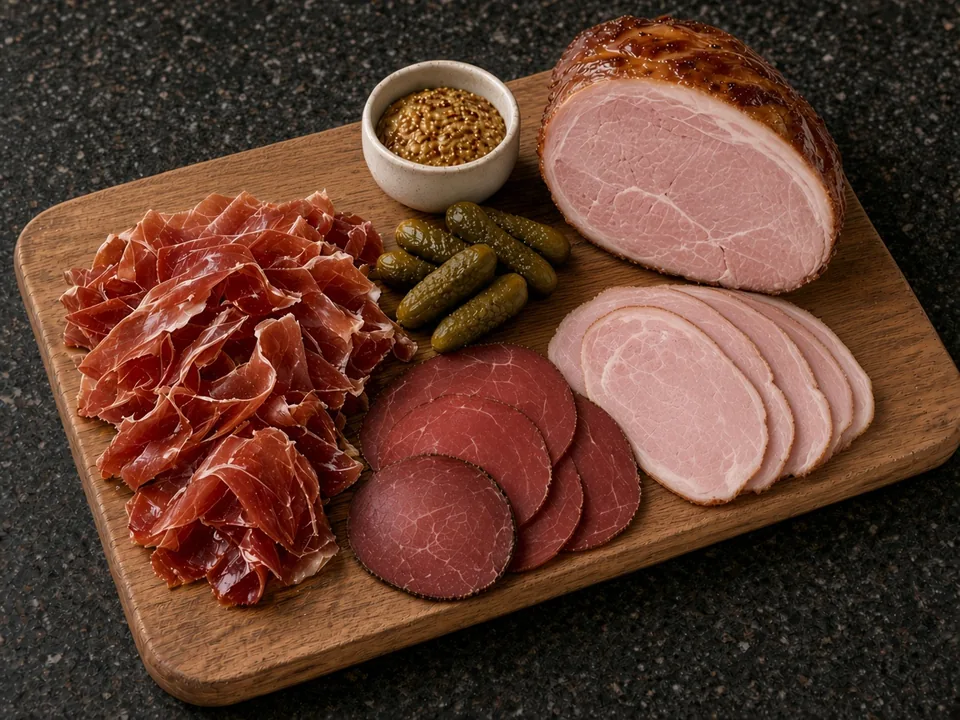
A board of different hams: air-dried, smoked and cooked ham with mustard and gherkins
A board of hams – illustration (AI-generated)

The basicsWhat is ham?

Ham is the hind leg of the pig, preserved with salt. The leg is either rubbed with dry salt or soaked in brine, separately from the rest of the carcass. Some hams are then smoked, and all are left to mature, from a few days to more than two years.

What happens next depends on the ham. Some are cooked before eating (boiled, baked or glazed); others are dried for so long that they are eaten raw, sliced paper-thin.

In French, jambon can also mean a fresh, uncured leg of pork, so check a French recipe before you shop. Want to cure your own? Start with our brine recipe.

In the shopsGammon or ham?

Gammon is the hind leg of the pig, cured in the same way as bacon (usually brined) and sold raw. You must cook it.

Once it is cooked, gammon is called ham. So a boiled or baked gammon joint becomes “ham” on the plate.

Ham is also the name for legs that are cured to be eaten without cooking, such as Parma, Serrano or Carmarthen.

Labels help: “cook thoroughly” means gammon, “ready to eat” means ham.

See How to Cook a Ham for soaking, boiling and glazing.

Reading the labelPDO, PGI and TSG

  • PDO (Protected Designation of Origin): every stage, from raising the pig to curing, happens in the named area under strict rules. Parma and San Daniele are PDOs.
  • PGI (Protected Geographical Indication): at least one stage, usually the curing, happens in the named area. Bayonne, Black Forest and Carmarthen are PGIs.
  • TSG (Traditional Speciality Guaranteed): protects a traditional method, not a place. Jamón Serrano is a TSG.
  • Since Brexit the UK runs its own schemes, which mirror the EU ones.

At a glance

HamFromStatusHow it’s eaten
York HamEnglandNo protected statusCook before eating
Wiltshire HamEnglandNo protected statusCook before eating
Bradenham HamEnglandNo protected statusCook before eating
Suffolk Black HamEnglandNo protected statusSold cooked, ready to eat
CumbrianEnglandNo protected statusRaw or cooked
Carmarthen HamWalesPGI (UK)Eaten raw
Parma HamItalyPDOEaten raw
San Daniele HamItalyPDOEaten raw
Serrano HamSpainTSGEaten raw
Jamón IbéricoSpainNational standard; four PDOsEaten raw
Bayonne HamFrancePGIEaten raw
Black Forest HamGermanyPGIEaten raw
Westphalian HamGermanyPGI (bone-in version)Eaten raw
Ardennes HamBelgiumPGIEaten raw
Virginia & Country HamUSANo protected statusCook before eating
Smithfield HamUSADefined by Virginia lawCook before eating
CoppaItalyCoppa Piacentina PDOEaten raw
Brunswick HamGermanyNo protected statusSold cooked, ready to eat
Dutch Charcoal HamNetherlands (by name)No protected statusSold cooked, ready to eat

British hams

Mostly cured legs that you cook: boiled, baked or glazed. Air-dried Carmarthen ham, and some Cumbrian hams, are eaten raw.

England · No protected status

York Ham

The classic English cooked ham: a dry-cured leg with a mild, delicate flavour, at its best carved cold.

Cook before eating
Status
No PDO or PGI.
Cure
Dry-cured: the leg is rubbed with salt (historically with saltpetre too), then hung to mature for about three to four months. A light mould on the rind is traditional.
Smoked?
Accounts differ: most describe it as unsmoked or only lightly smoked, and practice varies between makers.
Eat it
Cooked. It is soaked if salty, boiled or baked, then served cold, or hot with a sauce.

Best uses & serving ideas

  • Carved cold with English mustard, pickles and a crisp salad
  • Hot, with Madeira or parsley sauce (Escoffier thought it best served cold)
  • Sandwiches and a classic ham salad
  • Boil it, then glaze and bake for the Christmas table
York Ham in detail →

England · No protected status

Wiltshire Ham

The mild, moist, brine-cured ham behind most British gammon joints.

Cook before eating
Origin
Named after the Wiltshire cure, developed by the bacon curers of Calne, Wiltshire, above all C&T Harris.
Status
No PDO or PGI; “Wiltshire cure” describes a method.
Cure
Wet-cured: the pork is steeped in a brine tank for several days rather than rubbed with dry salt, then left to mature briefly.
Smoked?
Sold both ways: smoked, or unsmoked (“green”).
Flavour & texture
Milder, moister and less salty than a dry cure.
Eat it
Cooked. Sold raw as gammon, it becomes ham once boiled or baked.

Best uses & serving ideas

  • Everyday boiled ham, hot with parsley sauce or cold in sandwiches
  • Baked and glazed for a crowd
  • Gammon steaks with pineapple or a fried egg
  • Ham stock for pea soup

England · No protected status

Bradenham Ham

The famous English “black ham”: dry-cured, then steeped in molasses and spices until the skin turns coal-black.

Cook before eating
Status
No PDO or PGI. The original brand is rarely seen today; the style lives on in hams such as DukesHill’s Shropshire Black.
Cure
Dry-cured first, then steeped in molasses with spices and matured for several months. (Shropshire Black spends about two weeks in molasses, juniper and spices.)
Smoked?
Not usually described as smoked; the dark colour comes from the molasses.
Eat it
Cooked: soaked, then boiled or baked. It is usually served cold and sliced thinly.

Best uses & serving ideas

  • The centrepiece of a Christmas or Boxing Day cold table
  • Thin slices with Cumberland sauce and pickled walnuts
  • With mature Cheddar and chutney in a ploughman’s
Bradenham Ham in detail →

England · No protected status

Suffolk Black Ham

Suffolk’s sweet black ham, marinated in porter and molasses and smoked over beech.

Sold cooked, ready to eat
Origin
Suffolk. The best known maker is Emmett’s of Peasenhall, which has been curing there since 1820.
Status
No PDO or PGI.
Pig
Emmett’s uses free-range pigs from Blythburgh, Suffolk.
Cure
Dry-cured for about 7–12 days, then marinated for up to six weeks in black porter, molasses and brown sugar.
Smoked?
Yes, cold-smoked over beech.
Flavour & texture
Sweet, malty and smoky, with a dark rind.
Eat it
Cooked. Emmett’s sells it ready-cooked, off the bone, or sliced.

Best uses & serving ideas

  • Thinly sliced for a festive cold table
  • With fruit: oranges, figs or a fruity chutney
  • With hot buttered new potatoes and a green salad

England · No protected status

Cumbrian (Cumberland) Ham

Hand-rubbed, air-dried ham from the Lake District coast, made for cooking or for slicing thin and eating raw.

Raw or cooked
Origin
Cumbria. Richard Woodall of Waberthwaite is the best known maker.
Status
No PDO or PGI.
Cure
Dry-cured: rubbed by hand with salt (and spices), then hung to air-dry and mature for at least six months.
Smoked?
Usually not; Woodall’s Black Combe version is oak-smoked.
Flavour & texture
Firm, deep-flavoured and salty-sweet.
Eat it
Either: the air-dried ham is sliced thinly and eaten raw like prosciutto, and traditional Cumberland hams are also sold for cooking. Check the label: “ready to eat” means it can be eaten raw.

Best uses & serving ideas

  • Paper-thin slices on a British charcuterie board
  • Wrapped around asparagus or chicken before roasting
  • Diced and crisped over salads and soups

Wales · PGI (UK)

Carmarthen Ham

Wales’s protected air-dried ham, salted and dried in the Parma style.

Eaten raw
Origin
Carmarthen, West Wales.
Status
Protected Geographical Indication under the UK scheme (specification amended in October 2025).
Cure
The whole bone-in leg is dry-salted, then air-dried and matured for about six to nine months.
Smoked?
No.
Flavour & texture
Savoury and mellow, firm and silky when thinly sliced.
Eat it
Raw, thinly sliced, like Parma ham.

Best uses & serving ideas

  • With melon, figs or pears as a starter
  • On a Welsh platter with Caerphilly and laverbread crackers
  • Torn over salads or pizza after baking
  • Wrapped round chicken breasts or monkfish before roasting

Air-dried hams to eat raw

Salted and slowly dried for months, sometimes years. Never cook them for long; slice them thin and serve them at room temperature.

Italy · PDO

Parma Ham (Prosciutto di Parma)

Italy’s best-known air-dried ham: just pork and sea salt, aged for over a year in the hills of Parma.

Eaten raw
Status
PDO. A genuine ham is fire-branded with the five-pointed ducal crown.
Cure
Only sea salt, no other additives. The leg is salted, rested, then air-dried. Since September 2023 the minimum ageing is 14 months (previously 12). The trotter is removed.
Smoked?
No.
Eat it
Raw, sliced paper-thin.

Best uses & serving ideas

  • With melon or fresh figs
  • Draped over pizza after baking, or on bruschetta
  • Wrapped round grissini, asparagus or chicken (saltimbocca-style)
  • Stirred through pasta or risotto at the last minute
Parma Ham in detail →

Italy · PDO

San Daniele Ham (Prosciutto di San Daniele)

Friuli’s air-dried ham, pressed into its trademark guitar shape with the trotter left on.

Eaten raw
Status
PDO (a protected designation in Italy since 1970).
Cure
Sea salt only. The leg is salted, pressed into a flattened “guitar” shape and aged for at least 400 days (about 13 months) from salting; 430 days for pre-sliced packs. The trotter stays on.
Smoked?
No.
Eat it
Raw, thinly sliced.

Best uses & serving ideas

  • On its own with good bread
  • With melon, figs or fresh mozzarella
  • Wrapped round breadsticks for an antipasto board
San Daniele Ham in detail →

Spain · TSG

Serrano Ham (Jamón Serrano)

Spain’s everyday air-dried “mountain ham” from white pigs. Full Serrano & Ibérico guide →

Eaten raw
Status
Traditional Speciality Guaranteed (TSG), which protects the method, not a place. Regional designations include Jamón de Teruel PDO and Jamón de Trévelez PGI.
Cure
Dry-salted, rested, then air-dried and matured for at least 210 days (seven months) from salting, losing at least a third of its weight.
Smoked?
No.
Eat it
Raw, thinly sliced at room temperature.

Best uses & serving ideas

  • Tapas with bread, tomato and olive oil
  • Diced and fried briefly with vegetables (rehogado con jamón)
  • In croquetas, omelettes and over melon
Spanish ham guide →

Spain · National standard; four PDOs

Jamón Ibérico

Spain’s prized ham from black Ibérico pigs, graded by a coloured seal. The seals explained →

Eaten raw
Origin
South-west Spain and the Portuguese border country.
Status
Regulated by Spain’s Ibérico quality standard (Real Decreto 4/2014). PDOs: Guijuelo, Dehesa de Extremadura, Jabugo and Los Pedroches.
Pig & feed
Ibérico pigs, pure-bred or crossed (the label states 100%, 75% or 50% Ibérico). The finest are fattened on acorns in the open oak woodland (dehesa).
Cure
Dry-salted and slowly dried: at least 600 days for hams under 7 kg and 730 days for larger hams.
Smoked?
No.
Flavour & texture
Deep red, marbled with fat that melts at room temperature; nutty, sweet and long-lasting.
Eat it
Raw, hand-carved in thin slivers at room temperature.

Best uses & serving ideas

  • On its own, the star of the board
  • With a glass of fino or manzanilla
  • The bone and trimmings flavour stocks and bean stews
Spanish ham guide →

France · PGI

Bayonne Ham (Jambon de Bayonne)

The air-dried ham of the French Basque country and the Adour basin, cured with local salt.

Eaten raw
Status
PGI.
Cure
Dry-salted by hand with salt from the Adour basin salt works (Salies-de-Béarn, Bayonne-Mouguerre); no brine injection. Matured for at least seven months from salting.
Smoked?
No.
Eat it
Raw and thinly sliced; also cooked in Basque dishes.

Best uses & serving ideas

  • Thin slices with bread and butter
  • Piperade with eggs and peppers
  • Diced into omelettes, quiches and sautéed vegetables
Bayonne Ham in detail →

Smoked hams of northern Europe

Raw cured hams from Germany and Belgium, often smoked, eaten in thin slices.

Germany · PGI

Black Forest Ham (Schwarzwälder Schinken)

Germany’s best-selling raw ham: boned, spiced, cold-smoked over fir and nearly black outside.

Eaten raw
Status
PGI (since 1997).
Cure
Boneless, raw and dry-cured with salt, pepper, coriander, garlic and juniper.
Smoked?
Yes: cold-smoked at about 20–30°C for at least a week over Black Forest fir, then matured for several weeks.
Eat it
Raw, thinly sliced.

Best uses & serving ideas

  • On rye or dark bread with butter
  • With asparagus and new potatoes in spring
  • Diced into potato salad or Flammkuchen
Black Forest Ham in detail →

Germany · PGI (bone-in version)

Westphalian Ham (Westfälischer Schinken)

A big, robust ham from north-west Germany; the bone-in Knochenschinken is protected.

Eaten raw
Status
Westfälischer Knochenschinken (bone-in) is a PGI, registered in 2013.
Cure
The bone-in leg is dry-salted by hand for at least three weeks and matured for at least six months.
Smoked?
Either: smoked over beechwood, or air-dried only.
Eat it
Raw, thinly sliced.

Best uses & serving ideas

  • With pumpernickel, butter and a cold beer
  • With white asparagus and boiled potatoes
  • Sliced over a salad of beans and pears
Westphalian Ham in detail →

Belgium · PGI

Ardennes Ham (Jambon d’Ardenne)

Belgium’s protected ham from the wooded Ardennes, seasoned with juniper.

Eaten raw
Status
PGI.
Cure
Dry-salted or brined, always with juniper; whole hams mature for at least four months.
Smoked?
Optional: many are smoked over oak or beech.
Eat it
Raw, thinly sliced.

Best uses & serving ideas

  • With bread, butter and pickles
  • Wrapped round chicory (endive) and baked in cheese sauce
  • With melon or as part of a Belgian beer platter
Ardennes Ham in detail →

American country hams

Salty, dry-cured and aged hams from the American South. Soak them and cook them before eating.

USA · No protected status

Virginia & Country Ham

The salty, long-aged dry-cured ham of the American South.

Cook before eating
Status
No protected status. “Country ham” describes the style.
Cure
Heavily salted dry cure for one to three months, then hung to age for several months, sometimes years.
Smoked?
Usually, over hickory or oak.
Eat it
Cooked. Soak a whole ham for a day or more, then simmer or bake. Or slice it thin and fry it.

Best uses & serving ideas

  • Fried slices with “red-eye gravy” made with coffee
  • Thin slices in hot biscuits (scones)
  • A little diced into beans or greens
Virginia & Country Ham in detail →

USA · Defined by Virginia law

Smithfield Ham

The most famous Virginia country ham, legally tied to the town of Smithfield.

Cook before eating
Status
Defined by Virginia state law: it must be long-cured with dry salt and aged for at least six months, all within Smithfield’s town limits.
Cure
Dry salt cure, then smoked and aged for at least six months.
Smoked?
Traditionally, yes.
Eat it
Cooked: soaked well, simmered, then baked; served in thin slices.

Best uses & serving ideas

  • Shaved very thin on hot biscuits
  • A small amount goes a long way: use like Parmesan to season dishes
Smithfield Ham in detail →

Other cured pork and deli hams

Three hams from the old gallery that don’t fit the groups above.

Italy · Coppa Piacentina PDO

Coppa

Not strictly a ham: coppa is cured pork neck (collar), marbled and tender.

Eaten raw
Status
Several regional versions; Coppa Piacentina (Piacenza) is a PDO.
Cure
Dry-salted with spices, cased and air-dried; Coppa Piacentina matures for at least six months.
Smoked?
No.
Eat it
Raw, thinly sliced.

Best uses & serving ideas

  • Antipasto with olives and pickled vegetables
  • In panini with provolone
  • Torn over pizza or salads
Coppa in detail →

Germany · No protected status

Brunswick Ham

A German-style cured and beech-smoked ham, sold sliced and ready to eat in UK delis.

Sold cooked, ready to eat
Status
No PDO or PGI. UK supermarket versions are described as cured, beech-smoked and ready to eat.
Smoked?
Yes, over beech.
Eat it
Ready to eat as bought.

Best uses & serving ideas

  • Sandwiches and rolls with mustard
  • On a cold meat platter
  • Diced into omelettes or pasta
Brunswick Ham in detail →

Cook with ham

Sources for this page (39)
  1. Wikipedia – York ham
  2. Foods of England – York Ham
  3. Quality Pork Charter – traditionally cured Wiltshire bacon
  4. British History Online – VCH Wiltshire vol. 4 (industries)
  5. Country Life – Hooray for festive ham (2008)
  6. DukesHill – Shropshire Black ham
  7. Emmett’s of Peasenhall – Suffolk Black Ham
  8. Foods of England – Suffolk Ham
  9. Richard Woodall, Waberthwaite
  10. loveFOOD – meets a master curer (Woodall’s)
  11. UK Government – protected name: Carmarthen Ham
  12. Carmarthen Ham PGI product specification (2025)
  13. Consorzio del Prosciutto di Parma – new production rules (2023)
  14. European Commission – Prosciutto di Parma PDO
  15. Consorzio del Prosciutto di San Daniele – processing
  16. Consorzio del Prosciutto di San Daniele – how to recognise it
  17. Prosciutto di San Daniele PDO specification (disciplinare)
  18. Spanish Ministry of Agriculture (MAPA) – Jamón Serrano TSG
  19. Consejo Regulador – Jamón de Teruel PDO
  20. Consejo Regulador – Jamón de Trévelez PGI
  21. BOE – Real Decreto 4/2014, Ibérico quality standard
  22. ASICI (Ibérico interprofessional body) – seals and categories
  23. MAPA – Los Pedroches PDO specification
  24. INAO – Jambon de Bayonne PGI specification
  25. French Ministry of Agriculture – Connaissez-vous vraiment le jambon de Bayonne ?
  26. Schutzverband der Schwarzwälder Schinkenhersteller (Black Forest ham producers)
  27. EU GIview – Schwarzwälder Schinken PGI
  28. UK Government – protected name: Westfälischer Knochenschinken
  29. EUR-Lex – Implementing Regulation (EU) No 1085/2013 (Westfälischer Knochenschinken PGI)
  30. European Commission – Jambon d’Ardenne PGI
  31. Jambon d’Ardenne – cahier des charges (specification)
  32. Wikipedia – Country ham
  33. Code of Virginia § 3.2-5419 (Smithfield ham)
  34. Wikipedia – Smithfield ham
  35. Salumi Italiani – Coppa
  36. Consorzio Salumi Tipici Piacentini – Coppa Piacentina PDO
  37. Waitrose – German Brunswick Ham (product page)
  38. BBC Good Food – how to cook and prepare gammon and ham
  39. Love Pork (AHDB) – what’s the difference between gammon and ham?

The old photo gallery has been retired because we could not confirm the licence for its pictures. The illustration at the top of the page is AI-generated.

Updated 31 October 2026. Facts checked against the producers’ consortia, official registers and the other sources listed.