

Chicken Dishes
Roast Duck
Recipe No. 0661
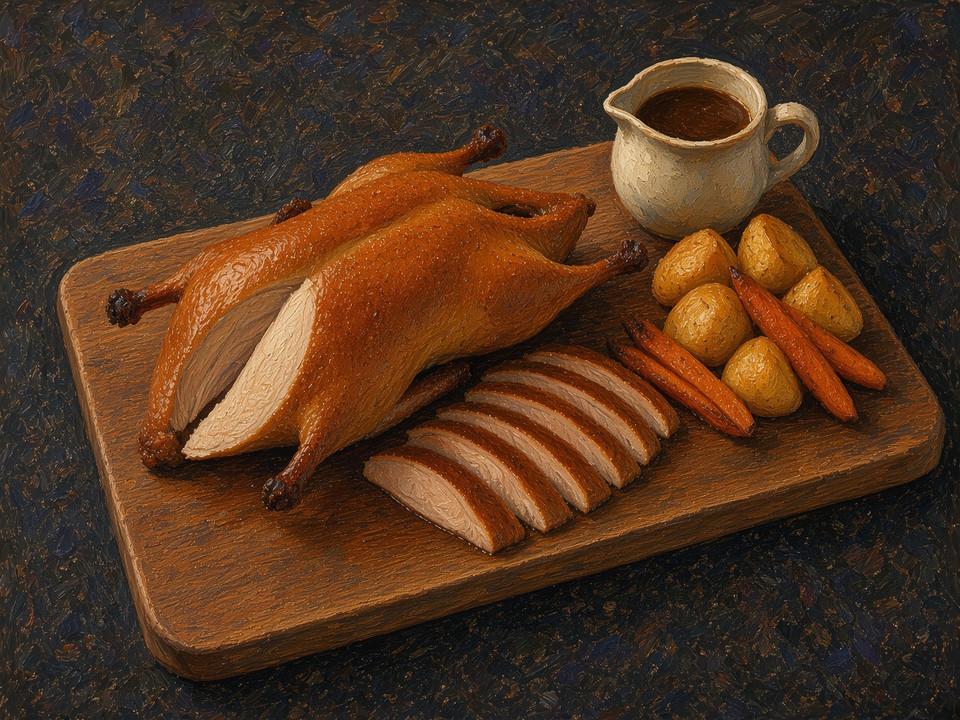
A whole roast duck the Chef Col way: the skin is dried and pricked, the bird starts in a hot oven then finishes at 180°C until the probe reads 75°C, the fat is poured off and saved, and the tin makes a simple gravy.
- Serves 4
- Cooking time about 1 hr for a 2 kg bird, plus 10–15 min resting
- British
- 2 kg whole duck
- Probe thermometer essential
The portions control scales the gravy and flavourings, not the bird’s cooking time. Use the actual weight of the duck and the probe; the timing guide does not change with portions.
Method
If you have time, take the duck out of its wrapping the day before, pat the skin very dry with kitchen paper and leave it uncovered on a rack in the fridge. This helps the skin crisp. If the bird was frozen, it must be fully thawed in the fridge first.
Take the duck (2 kg) out of the fridge about 1 hour before cooking. Remove any giblet bag and large lumps of fat from the cavity, but do not wash the bird. Wash your hands and clean surfaces after handling raw poultry. Heat the oven to 200°C (180°C fan) [400°F / gas 6].
Prick the skin all over with a skewer or the tip of a sharp knife, especially on the breast and around the legs and under the wings, piercing the fat but not the meat. Season generously with sea salt flakes and black pepper. Put the onion (1 onion), the orange half if using, and a sprig of thyme in the cavity if you like, for aroma only — cook any stuffing in a separate dish.
Sit the duck on a rack, or on the onion trivet, in a roasting tin, breast up. Roast at 200°C (180°C fan) [400°F / gas 6] for 15–20 minutes, until the skin has started to colour, then lower the oven to 180°C (160°C fan) [350°F / gas 4]. Roast until the thickest part of the thigh and of the breast both read 75°C [167°F] on a clean probe, away from the bone. As a guide, allow about 30 minutes per kg in total, including the hot start — about 1 hour for a 2 kg bird. Start probing 10–15 minutes early. The clock is for planning only.
While it roasts, carefully pour the rendered fat from the corner of the tin into a heatproof bowl two or three times, so the bird is not sitting in it. Save the fat: it is excellent for roast potatoes. If the skin is browning too fast, lay a loose piece of foil over the breast.
Take the duck out only when the probe reads 75°C [167°F] in the thickest part of the thigh and of the breast, and the juices run clear, with no pink. The Food Standards Agency and Food Standards Scotland advise cooking duck through, like chicken, to 75°C [167°F]. Lift it onto a board, cover loosely with foil and rest for 10–15 minutes. A smaller bird rises less than a large turkey, so we do not take it out early; the target is 75°C [167°F] in the oven, and it should still be at or a little above that after resting.
For the gravy, skim off the remaining fat, leaving the browned juices in the tin. Set the tin over a medium heat, stir in the flour (1 tbsp) and cook for a minute. Add the wine (100 ml), scrape up the browned bits and let it bubble, then add the hot stock (400 ml) and simmer for 5 minutes. Strain, taste and season. Carve and serve with the gravy.
Rate this recipe
Tried it? Rate it.
The readers’ average appears here once 5 readers have rated it.
One vote per recipe per browser, and you can change it. We keep only the stars: no name, e-mail or IP address. How ratings work
See also
Chef’s notes
- Oven and time: 200°C (180°C fan) [400°F / gas 6] for 15–20 minutes, then 180°C (160°C fan) [350°F / gas 4], about 30 minutes per kg in total, including the hot start. That is the figure on our Roasting Know How page. A 2 kg bird is about 1 hour as a first check. Some chefs use a longer, slower roast at 180°C; if the probe is short at the planned time, keep roasting and check every 10 minutes. The thermometer, not the clock, has the last word.
- Food safety: cook duck all the way through. Take it out at 75°C [167°F] in the thickest part of the thigh and of the breast, juices clear, no pink. The FSA and Food Standards Scotland treat duck like other poultry that must be cooked through. Unlike a large turkey, a duck has less mass, so we do not pull it early and wait for a big rise; rest it 10–15 minutes and keep it at or a little above 75°C [167°F].
- Duck has a thick layer of fat under the skin (Gisslen). Pricking the skin, starting hot, and pouring the fat off during cooking give you crisper skin and a good jar of fat for potatoes. Do not throw the fat away. Let it cool, then refrigerate; it keeps for weeks.
- This is a plain whole roast, cooked through. For a Chinese-style crispy duck with pancakes, see our Crispy duck. For a classic orange sauce, see Duck with orange sauce. Some chefs serve duck breast pink; that is a different method, usually with the breast cooked separately, and it is not what this recipe or the roasting page advises for a whole bird.
- Cook stuffing in a separate dish, not packed in the cavity. An onion, a piece of orange or a herb sprig in the cavity is only for aroma.
- Leftovers (UK FSA): carve remaining meat into small portions promptly; cool quickly and refrigerate within 2 hours. Eat within 48 hours, or freeze in labelled portions. Reheat only once, until steaming hot all the way through.
Safety guidance: FSA cooking food safely, Food Standards Scotland: cooking food safely, and FSA cooking and leftovers.
Weight and timing guide
These times follow our roasting page: 200°C (180°C fan) [400°F / gas 6] for 15–20 minutes, then 180°C (160°C fan) [350°F / gas 4], about 30 minutes per kg in total, including the hot start. They are a guide for planning only. Start checking early and take the bird out only when the probe reads 75°C [167°F] in the thickest part of the thigh and of the breast.
| Weight | Serves (guide) | Oven | Planning time (total) | Rest |
|---|---|---|---|---|
| 1.8 kg | 3–4 | 15–20 min at 200°C (180°C fan) [400°F / gas 6], then 180°C (160°C fan) [350°F / gas 4] | about 55 min | 10–15 min |
| 2 kg | 4 | 15–20 min at 200°C (180°C fan) [400°F / gas 6], then 180°C (160°C fan) [350°F / gas 4] | about 1 hr | 10–15 min |
| 2.2 kg | 4 | 15–20 min at 200°C (180°C fan) [400°F / gas 6], then 180°C (160°C fan) [350°F / gas 4] | about 1 hr 6 min | 10–15 min |
| 2.4 kg | 4–5 | 15–20 min at 200°C (180°C fan) [400°F / gas 6], then 180°C (160°C fan) [350°F / gas 4] | about 1 hr 12 min | 10–15 min |
Take it out at 75°C [167°F]. After a 10–15 minute rest it should still be at or a little above that temperature. Times per kilo are a guide only. If the reading is short, give it another 10 minutes and probe again.
A feast bird, cooked simply
Roast duck has been a feast dish in Britain for centuries, rich and a little ungenerous on meat — as cooks still find, there is a good deal of fat and a modest yield. The Chinese crispy style is a different tradition; our own crispy duck recipe covers that.
This page is the plain whole roast: dry skin, a hot start, the fat poured off, and the bird cooked through, with a simple gravy from the tin.
How this recipe was developed
The oven steps and the 30 minutes-per-kilo guide come from our Roasting Know How page (the old roasting chart’s times, kept when that page was written). The finish temperature is 75°C, from the Food Standards Agency and Food Standards Scotland, which replaced the old chart’s 80°C. We compared Delia Smith, Jamie Oliver’s roasting guide, Gisslen and BBC Good Food, then wrote our own method.
- Hot start, then 180°C, about 30 minutes per kg (our roasting page). That is the site’s agreed timing. Jamie Oliver’s roasting guide uses a slower 180°C throughout (about 2 hours for a 2–3 kg bird, 40 minutes’ rest, meat soft and not pink). Delia’s Roast Duck with Cherry Sauce also starts hot, then stays at 180°C for much longer. We keep the site’s shorter planning time, but the probe at 75°C [167°F] has the last word, so the bird stays in if it is not there yet.
- Dry and prick the skin, roast on a rack, and pour off the fat (Delia Smith, Gisslen, BBC Good Food). Delia seasons well, sits the duck on a rack and drains the fat several times, keeping it for potatoes. Gisslen notes the thick fat layer and the modest yield. BBC Good Food’s Crispy Roast Duck (4.5/5 from 2 ratings) pricks, salts and drains the fat. We follow that pattern, and suggest drying the bird uncovered in the fridge if there is time.
- Cook it through to 75°C [167°F] (FSA, Food Standards Scotland, our roasting page). Whole duck is not treated like a pink lamb joint. Some chefs cook duck breast separately and serve it pink; that is not this recipe. Rest for 10–15 minutes, as on the roasting page (Jamie’s guide allows 40 minutes for his slower method).
- A plain roast, not a second crispy duck or an orange sauce. Jamie Oliver also has a pancake-style roast duck with hoisin; we already have Crispy duck and Duck with orange sauce, so this page stays a straightforward whole roast with gravy.
Sources we compared (ratings as shown on each site on 12 November 2026):
- Cookeryonline: Roasting Know How (oven, times and 75°C finish)
- Food Standards Agency: cooking food safely (cook duck through)
- Food Standards Scotland: cooking food safely (75°C; duck cooked through)
- Delia Smith: Roast Duck with Cherry Sauce
- Jamie Oliver: handy guide to roasting meat
- BBC Good Food: Crispy Roast Duck (4.5/5, 2 ratings)
- Professional Cooking (Gisslen), chapters 16 and 18 — fat layer, roasting poultry, carryover
This is an original Cookeryonline recipe written in our own words. Ingredient choices and techniques are credited above; no source text has been copied.