

Fish & seafood · types
Types of Fish & Seafood
White and oily, round and flat, sea and freshwater; crustaceans, molluscs and cephalopods; and the classic cuts and folds, from darne to paupiette.
- 5 ways to sort fish
- 4 kinds of shellfish
- 12 cuts & folds
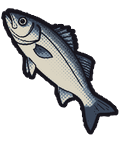
Fish are animals with backbones that live in water, breathe through gills and swim with fins; there are over 30,000 species. Cooks sort them in a few practical ways: by how much oil is in the flesh (white or oily), by shape (round or flat), and by where they live (sea, fresh water, or both). Shellfish are not fish at all, but crustaceans and molluscs. Each kind tells you something about how to buy, prepare and cook it.
Four ways to sort themFish
White fish
Translucent flesh that turns white and flaky when cooked; the oil is stored in the liver, so the flesh is lean. Mild in flavour; easy to overcook.
For exampleCod, haddock, hake, pollack, coley, whiting, monkfish, sea bass, bream; flat fish such as plaice, sole, turbot and halibut
Oily fish
Oil is spread through the flesh, often tinted pink, grey or brown. Rich in omega-3 fats; richer flavour; good grilled, barbecued, baked and smoked. The NHS advises at least one portion of oily fish a week as part of two portions of fish.
For exampleSalmon, trout, mackerel, herring, sardines and pilchards, anchovies, sprats, tuna, swordfish, eel
Round fish
Torpedo-shaped, swimming upright with an eye on each side and the backbone along the middle. They give two fillets, one from each side.
For exampleCod, haddock, salmon, trout, mackerel, herring, sea bass, bream
Flat fish
Bottom-dwellers that lie on one side, with both eyes on the upper, dark side and a white underside. They give four fillets, two from each side.
For examplePlaice, Dover and lemon sole, dab, flounder, megrim, turbot, brill, halibut; skate and ray are flat but have cartilage, not bones
Sea, freshwater & migratory
Most fish we eat live in the sea. Freshwater fish (trout, carp, pike, perch, zander) can taste muddier and are often bonier; migratory fish such as salmon, sea trout and eels move between the two.
For exampleSea: cod, mackerel. Freshwater: trout, carp, pike, perch, tilapia. Migratory: salmon, sea trout, eel, shad
Crustaceans and molluscsShellfish
Crustaceans
A hard, jointed outer shell and legs. They are sold live, cooked, or frozen.
For exampleCrab, lobster, langoustine (scampi), prawns, shrimps, crayfish
Bivalve molluscs
Two hinged shells that open and close. Buy them alive and tightly closed.
For exampleMussels, oysters, clams, cockles, scallops
Gastropods
A single, often spiral shell: sea snails.
For exampleWhelks, winkles, abalone (ormer), and land snails (escargots)
Cephalopods
Molluscs with an internal shell or none, a head and arms with suckers. Cook very fast or very slowly.
For exampleSquid (calamari), cuttlefish, octopus
Look any of them up in the fish & seafood A–Z.
The classic kitchen termsCuts & folds of fish
The French kitchen names for the ways fish is cut and shaped. Ask your fishmonger for any of them, or see preparing fish to do it yourself.
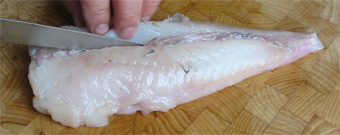
Fillet (filet)
A boneless piece cut along the length of the fish: two from a round fish, four from a flat fish. A whole side of salmon is a fillet too.
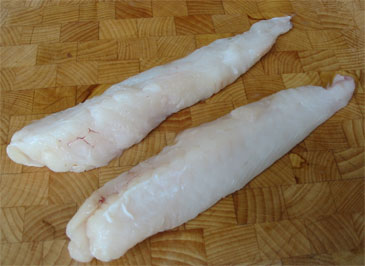
Supreme (pavé)
A neat, boneless portion cut from a large fillet, often on a slant. Restaurants now call a thick, square supreme a pavé (a paving slab).
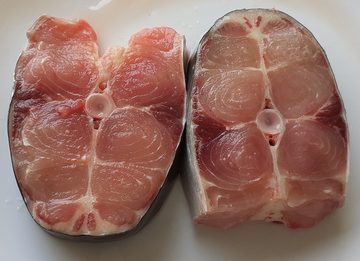
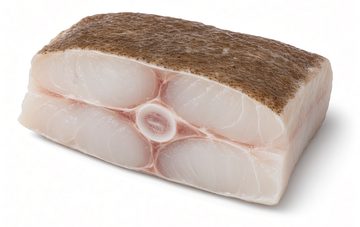
Darne
A thick steak cut across a round fish, through the backbone: a salmon or cod darne.
Photo: Pradeep717, Wikimedia Commons, CC BY-SA 4.0 (cropped)
Tronçon
A steak cut across a flat fish, through the bone: turbot and brill are cut into tronçons.
Illustration

Goujons
Strips of fillet about the size of a little finger, usually floured, egg-washed and breadcrumbed (pané), then deep-fried.
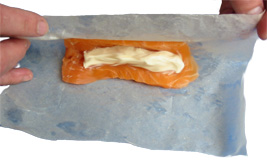
Paupiette
A thin fillet (sole or plaice) spread with a stuffing or fish mousse, rolled up and poached or baked.

Délice
A fillet folded neatly with the ends tucked underneath, ready for shallow poaching.

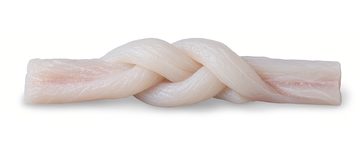
En tresse
A fillet cut lengthways into three strips and plaited, then poached or fried.
Cravate
A strip of fillet tied loosely in a knot (a necktie) before frying.
Illustration
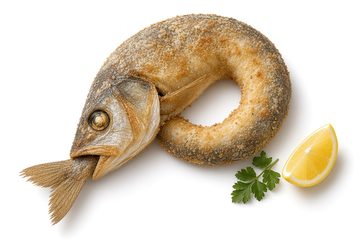
En colère
Whiting fried whole with its tail held in its mouth: the “angry” fish.
Illustration
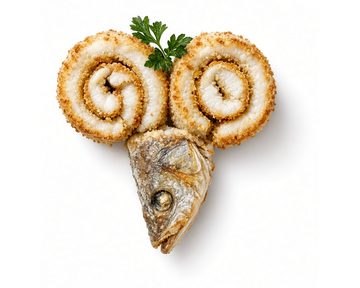
En lorgnette
Whiting with the backbone taken out from the head end, the two fillets rolled back towards the head like opera glasses, and fried.
Illustration
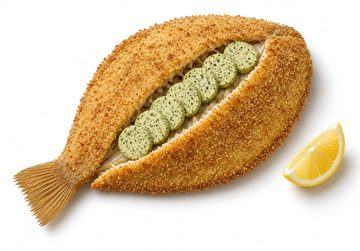
Colbert
Sole split along the backbone, breadcrumbed and fried; the bone is lifted out and the gap filled with parsley butter.
Illustration


Rewritten and updated 1 November 2026. Sustainability notes checked against the Marine Conservation Society and MSC on 1 November 2026; kit checked on Amazon.co.uk on 1 November 2026.