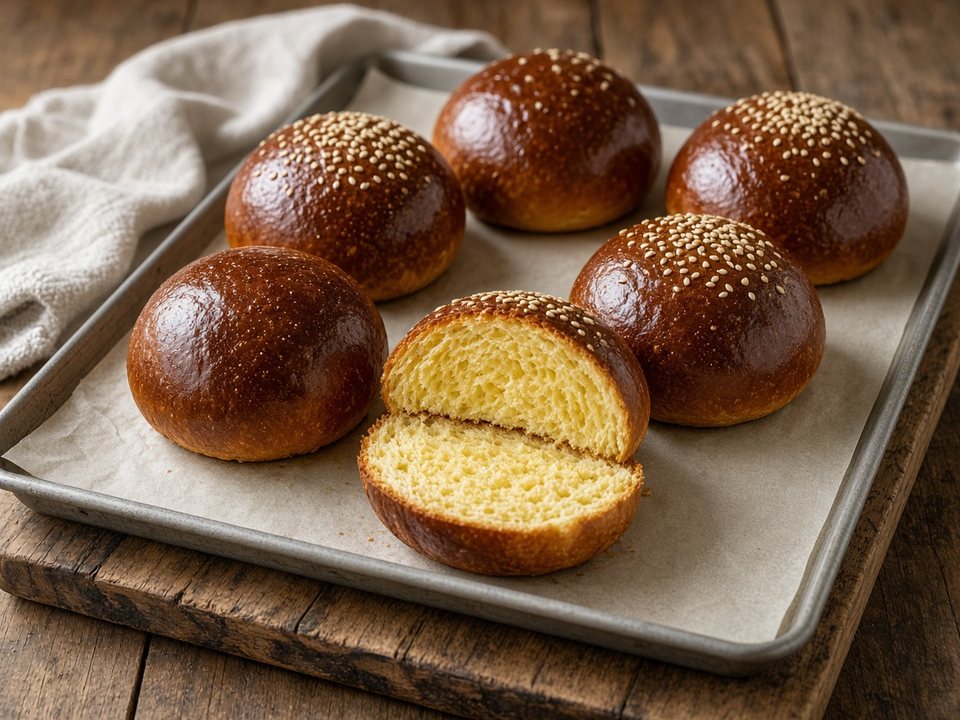
Knead by hand, stand mixer, bread machine, food processor or not at all; prove in bulk and after shaping; the windowpane and poke tests, cold retarding, warm spots, and how to tell over- from under-proved dough.
Scraper, banneton and probe thermometer · kit tiles link to similar products on Amazon (affiliate links)
GlutenWhy knead?
Two proteins in wheat flour, glutenin and gliadin, join with water to form gluten: stretchy strands that trap the gas the yeast makes. Kneading lines the strands up into a strong, elastic network. Time does the same job more slowly, which is why a wet dough left overnight needs no kneading at all.
Hand, mixer, machine, no-knead, processorFive ways to knead
By hand
10–15 minutes
Push the dough away with the heel of your hand, fold it back, turn it a quarter and repeat. Use as little extra flour as you can: a slightly sticky dough makes lighter bread. For very wet dough, slap it on the worktop, stretch it and fold it over (the French method).
Best for: Any dough up to about 1 kg of flour; you feel exactly when it is ready.
Stand mixer
6–8 minutes
Use the dough hook on a low speed (KitchenAid says speed 2, and no higher, for yeast doughs). Higher speeds strain the motor and warm the dough. Enriched doughs such as brioche take longer, 10–20 minutes, with the butter added a piece at a time.
Best for: Sticky, rich and large doughs; hands-free.
Bread machine dough cycle
1½–2½ hours, including the first rise
Add the ingredients in the maker’s order and choose Dough. The machine kneads and keeps the dough warm for its first rise; you shape and bake. See the dough cycle for rolls.
Best for: Rolls, buns, pizza and plaits with almost no effort.
No-knead, and stretch and fold
12–18 hours (no-knead) or 3–4 sets of folds
No-knead (Jim Lahey’s method, made famous by Mark Bittman in the New York Times, 2006): a very wet dough with a pinch of yeast, left for 12–18 hours, then baked in a hot lidded pot. Stretch and fold: in the first 1½–2 hours of the bulk rise, every 30 minutes, lift one side of the dough, fold it over, turn the bowl and repeat all round.
Best for: Wet, open-crumbed doughs: ciabatta, focaccia, sourdough. No mess.
Food processor
45–90 seconds
Pulse the dry ingredients, then pour in cool liquid with the motor running and process until a ball forms and rides round the bowl: about 60 seconds with the plastic dough blade (King Arthur), 45–90 seconds with the metal blade (America’s Test Kitchen). Cool water stops the dough overheating; finish with a minute of hand kneading.
Best for: Small batches of lean dough, fast; up to the size your processor allows.
The windowpane testIs it kneaded enough?
Windowpane testPinch off a walnut-sized piece and stretch it gently between your fingers. Well-kneaded dough stretches thin enough to let light through before it tears; if it tears straight away, knead for a few more minutes (King Arthur). Wholemeal, rye and very rich doughs never make a perfect windowpane: go by feel.
FeelSmooth and springy: press it and it slowly fills back; it is no longer shaggy or lumpy, and it holds a ball shape.
Do not overdo itBy hand you cannot over-knead. In a mixer or processor, over-kneaded dough turns slack and sticky and tears; stop as soon as it passes the windowpane test.
Two risesProving: bulk and final
Stage
What happens
How long / how to tell
Bulk (first) proof
After kneading, the whole dough rises in a covered, lightly oiled bowl. This is where most of the flavour develops.
About doubled: 1–2 hours at 24–26 °C (75–79 °F) for lean dough; enriched and wholemeal doughs are slower.
Knock back and divide
Press out the large bubbles gently (do not punch it flat), then divide by weight and pre-shape into loose balls.
Rest 10–20 minutes, covered, so the gluten relaxes.
Shape
Shape tightly: a taut skin gives a good rise and an even crumb.
—
Final proof
The shaped dough rises again on the tray, in the tin or in a banneton.
Puffy, not quite doubled, and passes the poke test: 30–45 minutes for rolls, 45–90 for loaves.
“Proving” (UK) and “proofing” (US) mean the same. Times are for a kitchen at about 22 °C (72 °F); go by the dough, not the clock.
Ready to bake?The poke test
Flour a finger and press it about 1 cm into the side of the dough.
What the dent does
Meaning
Springs back quickly, leaving no dent
Under-proved. Give it 10–15 minutes more and test again.
Springs back slowly, leaving a small dent
Ready: bake now.
Dent stays, or the dough sighs and sinks
Over-proved. Bake straight away for a flatter loaf, or knock it back, reshape and prove again for a shorter time.
Slow it downCold retarding in the fridge
What it isSlowing the dough down in the fridge (about 4 °C, 39 °F), either during the bulk rise or after shaping.
WhyBetter flavour (the slower rise gives the yeast and bacteria time to make more acids and aromas), an easier dough to shape, especially brioche, and baking on your timetable.
How longMost doughs 8–24 hours; up to 48–72 for lean pizza dough. Use less yeast for long retards (a third to a half).
ThenBulk-retarded dough: let it warm and relax for 40–60 minutes before shaping (King Arthur). Shaped rolls and loaves can often go straight from the fridge into the oven, or after 30–60 minutes out.
Where and how warmWarm spots for proving
Aim forDough at 24–27 °C (75–80 °F). Mix with lukewarm water (it should feel neither warm nor cold on your wrist) in a cold kitchen, and cool water in summer or in a machine.
Warm spots that workThe oven turned off with just the light on (check it with a thermometer: some get too hot), or with a tray of just-boiled water on the shelf below; a microwave with a mug of boiling water; an airing cupboard; the top of the fridge; a proving box.
Too warmAbove about 35 °C (95 °F) the dough rises fast but tastes of little, goes slack and can over-prove in minutes. Never put it on a radiator.
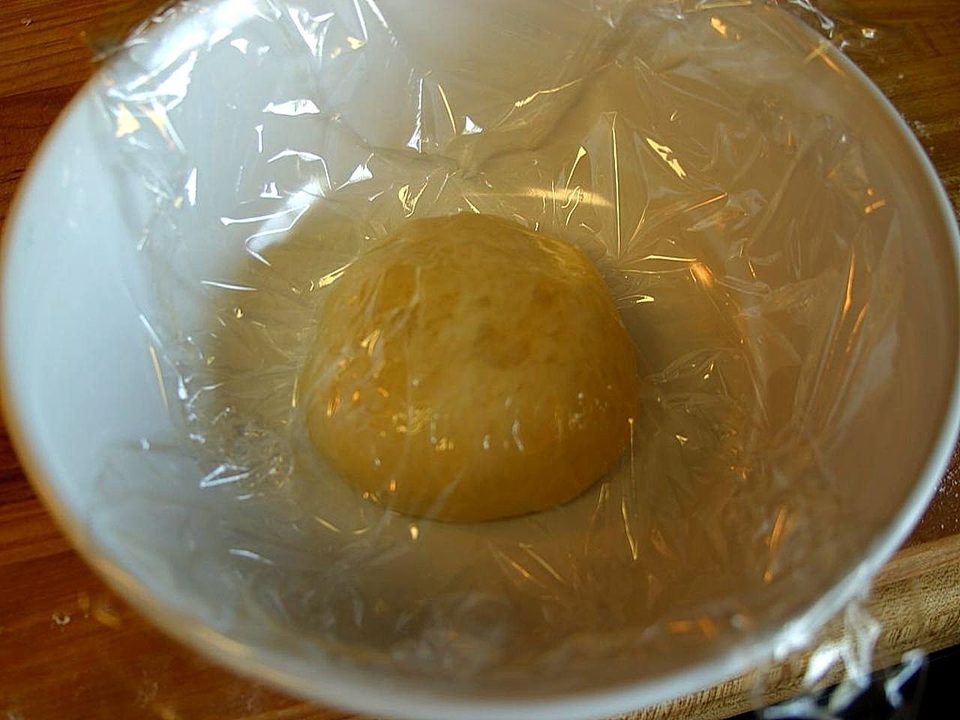
CoveringCover with an upturned bowl, a shower cap or oiled cling film so the surface does not dry and form a skin that stops it rising.
Reading the loafOver- or under-proved?
Signs
Under-proved
Dense and tight-crumbed; splits or bursts along the side in the oven; a very tall, rounded “flying” top crust; springs straight back when poked.
Well proved
Light and even; good oven spring; score marks open cleanly.
Over-proved
Spreads flat or collapses when scored or in the oven; large holes under the crust; a pale crust (the yeast has eaten the sugar); a sour, beery smell; a poke that never fills.
Oven spring, steam and donenessBaking bread
Oven springIn the first 10–15 minutes the gas in the dough expands and the yeast makes a last burst of gas, so the loaf rises fast. Then the crumb sets and the crust forms and browns.
Preheat wellAt least 20–30 minutes; longer with a baking stone or steel, which stores heat and gives a better rise and crust.
ShelfJust below the middle, with room for the loaf to rise without touching the shelf above.
SteamFor crusty bread, put an empty roasting tin on the oven floor while it heats and pour in a cup of boiling water as the bread goes in; or bake in a lidded cast-iron pot. Steam keeps the crust soft at first so the loaf can rise, then gives a glossy, crisp crust. Soft rolls and enriched dough need no steam.
Do not open the doorNot for the first 15 minutes, while the loaf is rising.
TemperaturesCrusty loaves and rolls: 220°C (200°C fan), gas mark 7, 425°F (crusty rolls up to 230°C (210°C fan), gas mark 8, 450°F). Sandwich loaves and soft rolls: 200°C (180°C fan), gas mark 6, 400°F. Sweet and enriched (brioche, milk bread, buns): 190°C (170°C fan), gas mark 5, 375°F.
Is it done?Tap the base: it should sound hollow, and the sides should feel firm. Surer: a probe in the middle reads 93–96 °C (200–205 °F) for lean bread and 88–90 °C (190–195 °F) for soft and enriched bread (King Arthur).
Cool itOn a rack, at least an hour for a loaf: the crumb is still setting, and cutting it hot makes it gummy.
From the old Baking Bread page. The old Baking Bread page said bread “is baked at a high temperature to kill the yeast and stop the dough from over proofing and collapsing”, suggested “somewhere between 200ºC, 400ºF gas 6 and 180ºC, 350ºF gas 5”, and gave the internal temperature as “around 195ºF or 100ºC” (sic). The two halves of that do not match: 195 °F is about 90 °C, and 100 °C is boiling, which the inside of a loaf never reaches. Its advice to use a baking stone to “simulate the conditions in a brick (sic) said to be ideal for bread baking” (a brick oven) still stands.
Bread and roll recipes on CookeryonlinePut it to work
Rewritten and updated 1 November 2026. Machine picks checked against BBC Good Food, Which?, Wirecutter and Serious Eats, and on Amazon.co.uk, on 1 November 2026.