

Knives · for the cheese board
Cheese Knives
The classic forked cheese knife for slicing firm and hard cheeses, plus wires, planes and other knives for soft and crumbly cheeses.
- Hard · soft · crumbly
- Knives, wires and planes
- One knife per cheese
 Shop similar cheese knives on Amazon (opens in a new tab)
 Shop similar cheese knife sets on Amazon (opens in a new tab)
What it’s for
The classic shape is designed to slice firm and hard cheeses and then neatly pick up the slices with its forked end. This type of knife is used at the table, on a cheese board.
Different cheeses need different tools. Here are the main ones, from the classic knife to wires and planes.
Types
- Shop similar cheese knives on Amazon (opens in a new tab)The classic cheese knifeSlices firm and hard cheeses, then picks up the slice with its forked tip.Find on amazon.com
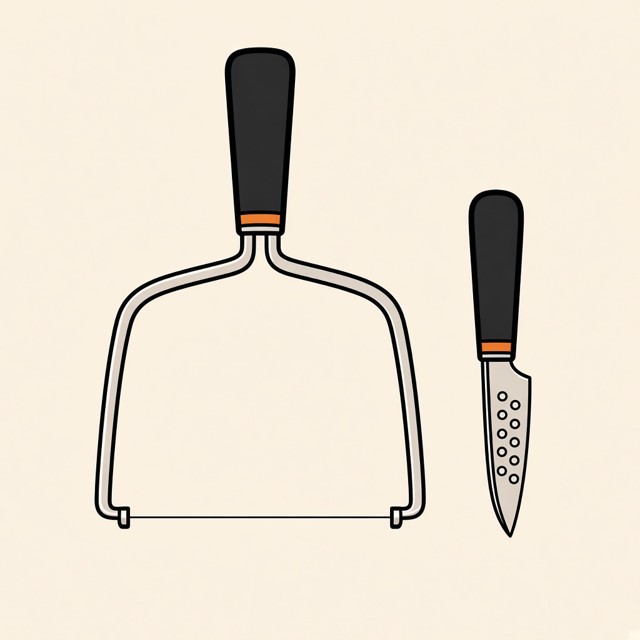
 Shop similar open-blade cheese knives on Amazon (opens in a new tab)Open-work bladeClassic cheese knives tend to drag on the cheese and compress the slices; a blade with holes in it lets in air, so the cheese does not stick and slices evenly.Find on amazon.com
 Shop similar cheese wire slicers on Amazon (opens in a new tab)Wire cheese slicerFor hard and semi-hard cheeses, a stainless-steel wire cuts thinner slices than a knife can, without the pressure on your hands.Find on amazon.com
 Shop similar marble cheese boards with wire on Amazon (opens in a new tab)Wire on a marble boardWires are also made on marble or wooden boards, for easy slicing of larger blocks of cheese.Find on amazon.com
 Shop similar cheese planes on Amazon (opens in a new tab)Cheese planeTakes a thin, even slice in one smooth stroke: thinly sliced hard cheese shows off its flavour, and thin slices are hard to cut with a knife. Some graters have one built in.Find on amazon.com
- Shop similar cheese knife sets on Amazon (opens in a new tab)Speciality knivesA pointed knife breaks Stilton, aged Cheddar, Parmesan and pecorino into pieces; a narrow blade cleanly slices semi-soft cheeses such as Brie, Camembert and Jarlsberg; a wide blade does the same for soft, crumbly cheeses.Find on amazon.com

BuyingHow to choose
- For a cheese board: a small set (a forked knife, a pointed knife and a wide blade) covers most cheeses.
- For cooking: a wire or plane for even slices of hard cheese; a grater for Parmesan.
- One knife per cheese on the board, so blue cheese does not end up in everything else.
Keep it sharp and safeCare
- Wash by hand in hot soapy water and dry straight away. Dishwashers dull the edge, knock the blade against other things and can crack wooden handles.
- Store it safely in a knife block, on a magnetic rack or in a blade guard, never loose in a drawer where the edge gets chipped (and so do fingers).
- Cut on wood or plastic. Glass, marble, slate and ceramic boards blunt an edge very quickly.
- Hone little and often with a steel, and sharpen only when honing no longer brings the edge back. See Sharpening.
- Wipe the blade between cheeses, and replace a cheese wire when it stretches or kinks.
A little history
The cheese plane
The cheese plane (ostehøvel) is a Norwegian invention. Thor Bjørklund, a cabinetmaker from Lillehammer, based it on the woodworking plane he used in his shop; he applied for the patent in February 1925 and began making them in 1927.
Put it to work

Sources (2)
Tidied and updated 1 November 2026. Products checked on Amazon.co.uk on 1 November 2026.