

Care · honing and sharpening
Sharpening Knives
The difference between honing and sharpening, the tools for each (steels, stones, pull-through and electric sharpeners) and how to use a steel.
- Hone often
- Sharpen occasionally
- Steel · stone · sharpener
 Shop similar sharpening steels on Amazon (opens in a new tab)
 Shop similar knife sharpeners on Amazon (opens in a new tab)

What it’s for
There are two processes involved in keeping knives sharp: regular honing and occasional sharpening.
Honing with a steel straightens and smooths the edge and keeps a sharp knife sharp; do it often, even every time you use the knife. Sharpening with stones, grinders or sharpening machines grinds away metal to restore a dull blade. It wears the blade much more quickly than a steel, so do it only when honing no longer brings the edge back.
The tools
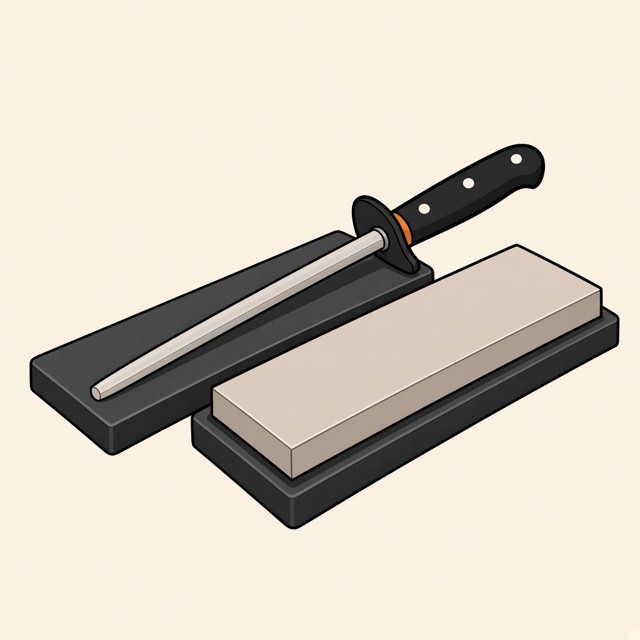
- Shop similar sharpening steels on Amazon (opens in a new tab)SteelA rod of hard, ridged steel for honing. Diamond and ceramic “steels” also remove a little metal, so they sharpen lightly as well.Find on amazon.com
- Shop similar knife sharpeners on Amazon (opens in a new tab)Pull-through and electricQuick and easy: preset slots hold the angle for you. Some remove a lot of metal, so use them sparingly.Find on amazon.com
BuyingHow to choose
- Every kitchen needs a steel (or a ceramic or diamond rod) for regular honing.
- For sharpening, a combination whetstone gives the best edge if you will take the time to learn; a good pull-through sharpener is the easy option.
- Japanese knives usually have a finer angle than European ones: use a sharpener that suits them, or a stone.
- Serrated knives need a tapered rod or a professional; most ordinary sharpeners will spoil them.
Keep it sharp and safeCare
- Test the edge on a sheet of paper or a ripe tomato: a sharp knife slices cleanly without pressure.
- Wipe the blade after honing or sharpening to remove the metal dust.
- Professional sharpening once a year or so is worth it for good knives.
How to use a steel
- Steady the steel
Hold it upright with the tip resting on a board on a damp cloth, so it cannot slip.
- Find the angle
Put the heel of the knife against the top of the steel with the blade at about 15–20° (roughly half of 45°, then half again).
- Draw it down
With light pressure, draw the blade down and towards you so the whole edge, heel to tip, passes along the steel.
- Alternate sides
Repeat on the other side of the steel. Five or six strokes a side is plenty; wipe the blade afterwards.
Tidied and updated 1 November 2026. Products checked on Amazon.co.uk on 1 November 2026.